Zuppa gallurese (suppa cuata)
Price on request Discover
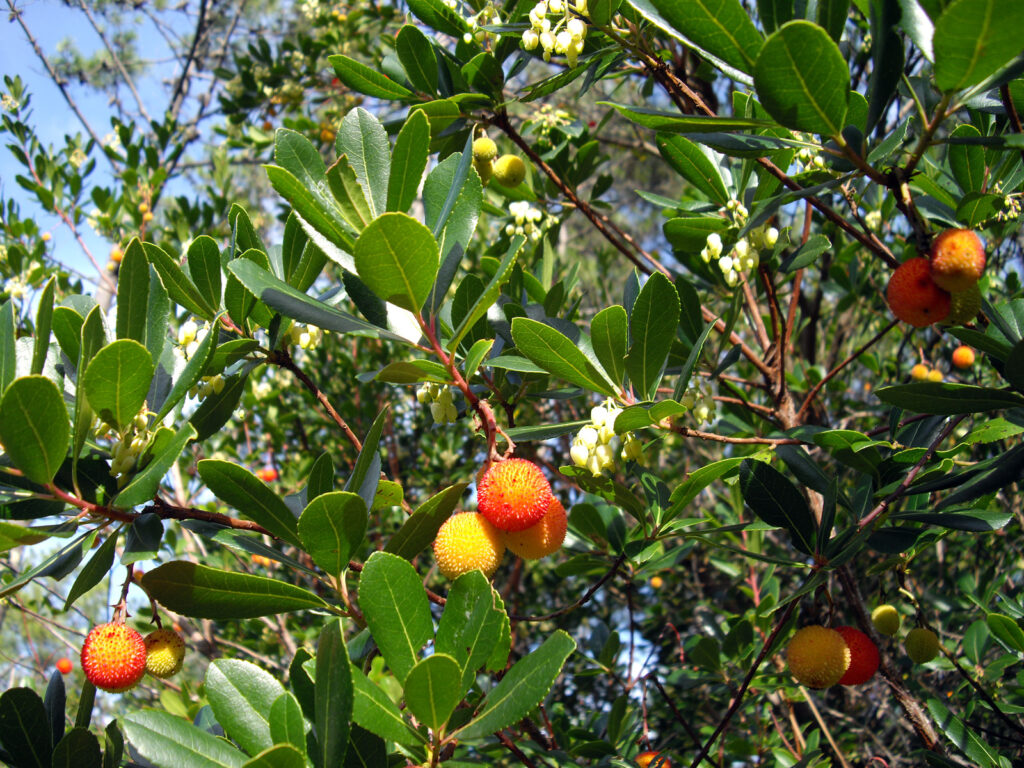
Some honeys are sweet and easy. Sardinia’s bitter strawberry tree honey (miele amaro di corbezzolo) is neither, and that is exactly why people fall for it. Dark-scented, intense and unmistakably bitter, it is made when the rest of the island is heading into winter, as the strawberry tree blooms with white bell-shaped flowers right beside its ripe red berries.
The strawberry tree (Arbutus unedo) is one of the signature shrubs of the Sardinian maquis, known locally as lidone or olioni. It flowers while the fruit from the previous year’s blossom ripens, so flowers and berries hang on the same branch. Sardinian honey’s unusual taste was noticed long ago: the Roman poet Horace, in his Ars Poetica, lists “Sardinian honey” among the things that can spoil a dinner, a line usually read as a reference to its bitterness. Today that “flaw” is a prized speciality, listed by the Region of Sardinia among its Traditional Agri-food Products (PAT) as Miele di Corbezzolo di Sardegna.
The regional description speaks of a lightly amber honey with grey-green hints and a decidedly bitter, intense and lingering taste, with fine crystallisation. Tasters often find notes of coffee and herbs and a slightly smoky finish. The bitterness comes naturally from the strawberry tree’s nectar.
Making it is hard work. The late bloom, between autumn and winter depending on area and year, coincides with mistral winds, rain and short days, so bees fly little and some years yield almost nothing. Winter humidity also makes the honey prone to fermentation, so many beekeepers use dehumidifiers. The honey is extracted by centrifuge, then filtered, settled and matured. It is produced across the whole of Sardinia, wherever the maquis is rich in strawberry trees.
It has no PDO or PGI. Its official recognition is the PAT listing, which safeguards traditional products and know-how. Look for “miele di corbezzolo” and Sardinian origin on the label, and buy from the beekeeper whenever you can.
The classic pairing, also suggested by the regional description, is with aged pecorino and drizzled over hot seadas, the fried cheese pastries of Sardinia. It also works with blue or aged cow’s milk cheeses, fresh sheep’s ricotta, grilled bitter greens, and even half a teaspoon in espresso. Use it raw or add it at the end so its aroma survives.
The best way to discover it is to visit a producer: beekeepers across the island welcome visitors for tours and tastings. You’ll also find it at farmers’ markets, local food shops and honey and food fairs held in various towns. The new honey usually appears early in the year, after the winter extraction. Always ask about the vintage: every year is different, and some years there is none at all.
The bitterness is completely natural and comes from the nectar of the strawberry tree flowers. It is the honey’s signature, not a defect.
The strawberry tree flowers between autumn and winter, so the harvest happens in the cold months. Production is small and varies greatly from year to year.
No. It is recognised as a Traditional Agri-food Product (PAT) of the Region of Sardinia.
Do you run activities in Sardinia?
Get your own page on Ajò Sardegna: free until 31 May 2027, no commissions, with customer requests coming straight to you. If you like, we prepare the page for you.
Hi!
Can I help you?
Lia is an AI-based virtual assistant and can make mistakes: always check with the operator. Please don't share personal data. Privacy