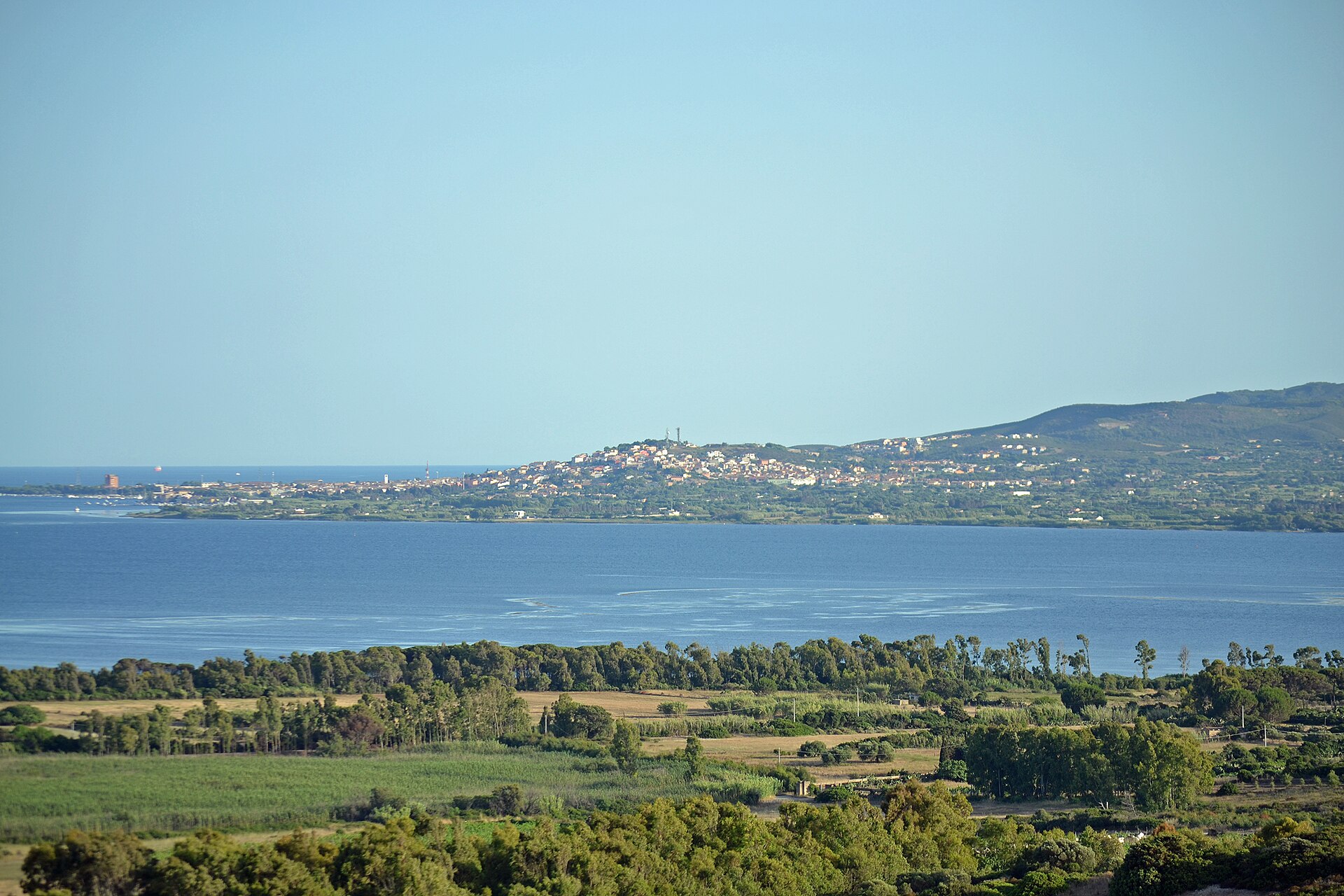
An island linked to Sardinia by a narrow isthmus, a town founded by the Phoenicians almost three thousand years ago, catacombs, flamingos, coves of volcanic rock and the last remaining thread of Mediterranean sea silk (byssus): what to see in Sant’Antioco is a constant discovery, far from the crowds and full of stories worth hearing.
In this guide you’ll find the 13 stops not to miss in Sant’Antioco, from ancient Sulky to the underground village, followed by the beaches, the experiences to try, the history, the dishes and wines to taste, the festivals and all the practical information: how to get there, where to park, when to go and how many days to stay.
Contents
Whoever touches the sea silk touches the sea, and the sea is not for sale.
Ancient oath of the sea silk masters of Sant’Antioco
Why visit Sant’Antioco
Sant’Antioco is an island in the south-west of Sardinia, in the Sulcis region, joined to the mainland by an isthmus and a bridge. At more than 100 km², it is one of the largest islands in Italy. The territory is split between two municipalities: Sant’Antioco, the main town with around 11,000 inhabitants, and Calasetta to the north, which was settled by people of Tabarchino (Ligurian) origin.
The town stands on the ruins of Sulky, one of the oldest cities in Italy, founded by the Phoenicians in the 8th century BC. Even today the streets of the centre rest on layers of history: Phoenician, Punic, Roman and Christian. Alongside the archaeological sites you’ll find a wild coastline, a lagoon with salt pans and a craft tradition found nowhere else in the world: that of sea silk, or byssus.
Sant’Antioco appeals to anyone who values authenticity, loves archaeology, calm seas and good wine. If you’re wondering what to see in Sant’Antioco, be prepared to go from the catacombs to a turquoise cove in the same afternoon, with no queues and no rush.
What to see in Sant’Antioco: the 13 stops not to miss
1. The Tophet of Sulky
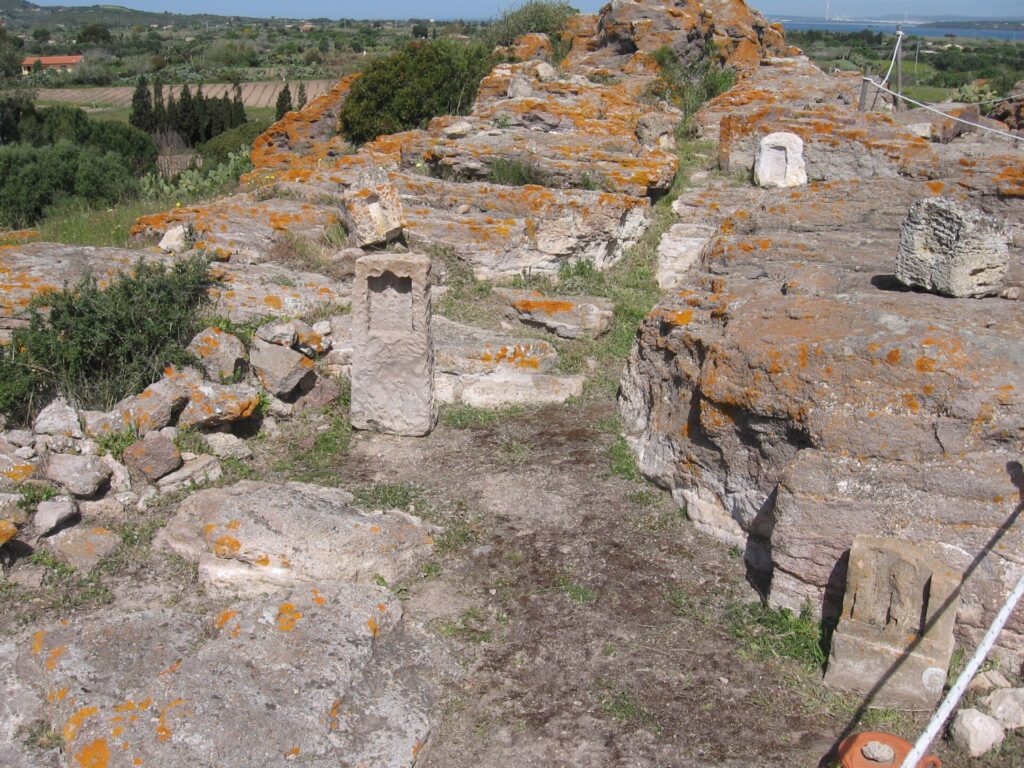
On a hill just outside the centre lies one of the most important Phoenician-Punic sanctuaries in the Mediterranean. The tophet was a sacred area where urns containing the ashes of children who had died very young were placed, together with carved votive stelae. Walking among the trachyte rocks and the stelae is a deeply moving experience.
2. The Ferruccio Barreca Archaeological Museum
A modern museum housing the finds from Sulky: stelae from the tophet, pottery, jewellery, statues, Roman mosaics and a reconstruction of a Punic house. It’s the key to understanding everything else you’ll see in town. Next door is the Punic necropolis, with chamber tombs cut into the rock.
3. The Basilica of Sant’Antioco Martire
In the heart of the old town, the basilica has early Christian origins and has been remodelled over the centuries. It holds the relics of Saint Antiochus, the martyr who, according to tradition, brought Christianity to the island and who is the patron saint of Sardinia.
4. The catacombs
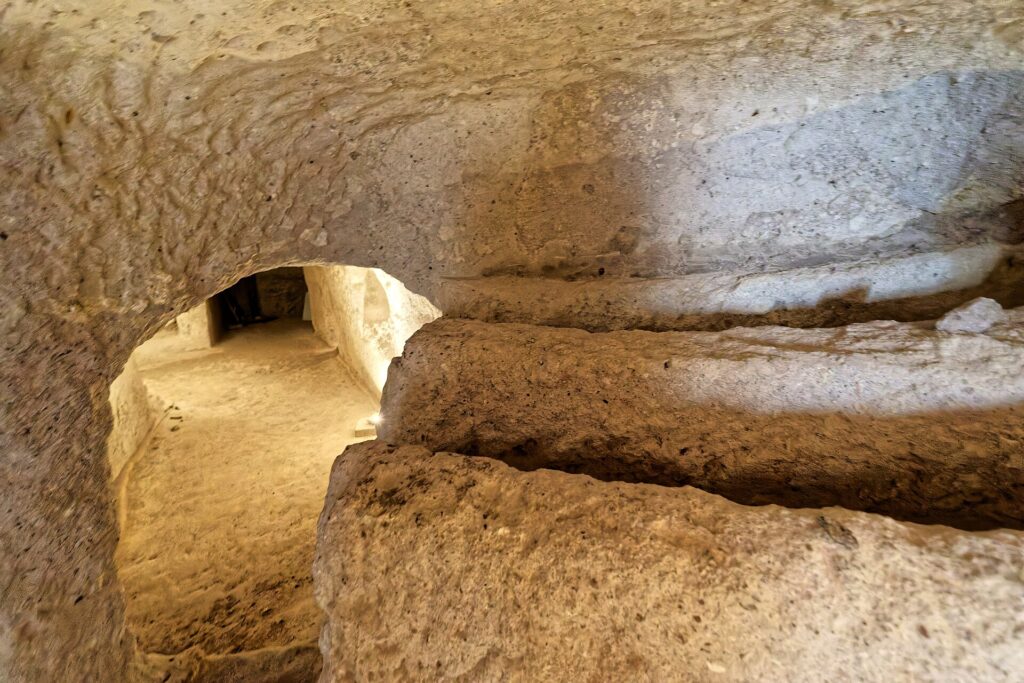
Beneath the basilica lies a maze of catacombs, created from ancient Punic tombs and used by the first Christians. They are one of the rare examples of catacombs in Sardinia: corridors, niches, frescoes and the saint’s tomb. The guided tour lasts about half an hour.
5. The underground village
On the slopes of the hill, Punic rock-cut tombs were reused as homes until after the Second World War: the poorest families lived here, in underground dwellings known as is gruttas (the grottoes). Some can be visited today, and they tell a story of poverty and ingenuity.
6. Forte Su Pisu
A small Savoyard fort built in the early 19th century looks down over the town. It was the scene of a pirate attack in 1815. From the terrace there are fine views over the centre, the lagoon and the Gulf of Palmas.
7. The Ethnographic Museum
Housed in an old wine warehouse, Su Magasinu ‘e su Binu, the museum tells the story of the island’s farming and seafaring life: farm tools, looms, fishing equipment and winemaking implements. A step back into the Sardinia of yesterday.
8. Sea silk
Sea silk, or byssus, is a fibre produced by the Pinna nobilis, a large Mediterranean mollusc. For centuries the women of Sant’Antioco spun and wove it into golden fabrics that were featherlight and precious. Today the tradition survives thanks to a handful of guardians and a small dedicated museum: hearing its story is one of the most moving experiences on the island.
9. The seafront and the harbour
The Lungomare Cristoforo Colombo, with its palm trees and fishing boats, is where everyone comes for the evening stroll. Boat trips and fishing excursions (pescaturismo) leave from the harbour.
10. The salt pans and the flamingos
Along the isthmus that links the island to Sardinia, the salt pans and lagoon are home to hundreds of pink flamingos, herons and black-winged stilts. At sunset the water shifts from pink to orange: not to be missed.
The salt pans have played an important part in the island’s economy since antiquity: salt was gathered by hand and loaded onto boats bound for the mainland. Today the lagoon is an area of great natural value, where many species of water birds nest. The best time to watch them is at dawn, when the light is soft and there’s still little traffic on the isthmus.
11. The west coast
The western side of the island is wild and spectacular: cliffs of volcanic rock, sea stacks, caves and coves reached by footpaths. Some of the loveliest sunsets in southern Sardinia can be seen here, with the island of San Pietro on the horizon.
12. Capo Sperone
At the southern tip, the headland of Capo Sperone looks out over the open sea, with a coastal tower and a view that takes in the Toro and Vacca islands. It’s a windswept, solitary spot, perfect for lovers of unspoilt nature.
13. Calasetta
At the north of the island, Calasetta is a town of Ligurian-Tabarchino origin, with whitewashed houses, a grid of streets and a Savoyard tower. Ferries to Carloforte leave from its port. The nearby beaches, such as Sottotorre and Spiaggia Grande, are among the most popular.
The best beaches in Sant’Antioco
The sea is an essential part of what to see in Sant’Antioco: the beaches are less crowded than elsewhere and offer very different settings.
- Maladroxia: a bay of golden sand with shallow water and a thermal spring nearby. Well suited to families.
- Coaquaddus: a broad beach of fine sand on the south-east coast, with dunes and Mediterranean scrub.
- Cala Lunga: a long inlet squeezed between rocks, with calm, turquoise water.
- Turri: a small sandy beach near Capo Sperone, wild and scenic.
- Is Praneddas: a cove of pebbles and rocks, ideal for snorkelling.
- Grotta dei Colombi and the west-coast coves: reached on foot or by boat, among volcanic rocks.
When the maestrale (north-westerly wind) blows, the beaches on the east and south-east coast are more sheltered; when the scirocco (south-easterly) is up, choose the west coast. For more ideas on the sea, read our guide to boat trips in Sardinia.
Carignano and the vines growing in sand
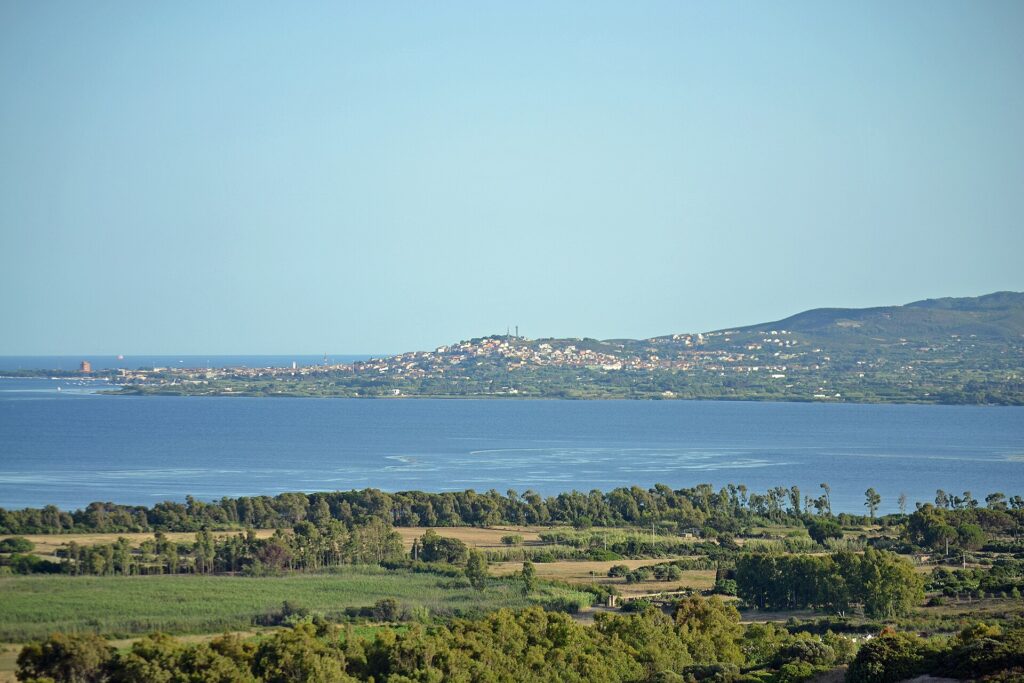
Sant’Antioco is one of the capitals of Carignano del Sulcis, a deep, smooth red wine with aromas of dark fruit, Mediterranean scrub and a salty note reminiscent of the sea. Many vineyards grow in sandy soil close to the coast, a piede franco (on their own roots): the vines are not grafted because phylloxera, the insect that devastated Europe’s vineyards in the 19th century, cannot survive in sand.
The vines are often trained in the alberello style, low and bent by the wind, just as they were centuries ago. Visiting a winery, strolling between the rows and tasting the wine alongside the person who made it is one of the loveliest ways to get to know the island. As well as Carignano, the area produces fragrant whites such as Vermentino and sweet dessert wines.
Tips for a perfect visit
- Book guided visits to the catacombs, underground village and tophet: in summer the groups fill up quickly. A combined ticket is often available.
- Visit the archaeological sites in the morning: the tophet and necropolis are outdoors and it gets very hot in summer.
- Wear closed shoes on the west-coast paths, which are rocky and in places exposed.
- Check the wind before choosing a beach: the island is very exposed, and a drive of just a few kilometres can take you to calm water.
- Carry cash: some shops, kiosks and small wineries don’t always take cards.
- Respect the flamingos: watch them from the roads and viewpoints, and don’t approach the pools.
Things to do in Sant’Antioco: experiences to enjoy
Once you’ve decided what to see in Sant’Antioco, choose the experiences that will let you get to know it up close.
- By e-bike: the e-bike tour of the island, the sunset in the salt pans among the flamingos, the Carignano tasting in the vineyard and the coal road to the Grande Miniera di Serbariu.
- By kayak: the tour along the island’s coast and the sunrise kayak in the lagoon, with breakfast.
- With Ziru Tour: all their offers are on the Ziru Tour page.
- Snorkelling and diving along the west coast and around the Toro and Vacca islands.
- Fishing trips (pescaturismo): a day out with local fishermen; read our guide to fishing trips in Sardinia.
- Trekking on the west-coast paths and towards Capo Sperone.
All the experiences in the area, with direct contact and no commission, are on the page things to do in Sant’Antioco.
A brief history of Sant’Antioco
The island was inhabited as far back as the Neolithic and the Nuragic age, as the nuraghi and giants’ tombs scattered across the territory show. Around the 8th century BC the Phoenicians founded Sulky, one of their main ports in the western Mediterranean. Under the Carthaginians the city grew further, then passed to the Romans, who made it an important municipium.
In the 2nd century AD the Christian physician and preacher Antiochus is said to have died here as a martyr: his cult gave the island its name. In the Middle Ages raids from the sea depopulated the city, which slowly came back to life from the 18th century. In the 19th century the Sulcis mines arrived, along with the salt pans and the port for exporting ore.
Today Sant’Antioco lives off fishing, farming, wine and tourism, and guards its thousand-year history with pride.
What to eat and drink in Sant’Antioco
The island’s cooking brings together sea, lagoon and countryside. Dishes to try:
- burrida, small-spotted catshark marinated with walnuts, vinegar and garlic;
- fregola with arselle (Sardinian pasta with small clams) and fish soups;
- tuna, the star of Sulcis cooking, fresh or preserved in oil;
- grey mullet from the lagoon and bottarga (cured mullet roe);
- almond sweets and traditional bread;
- Carignano del Sulcis, the red wine that is the emblem of the area, also grown in ungrafted vineyards close to the sea.
Restaurants and trattorias are listed on the page where to eat in Sant’Antioco; for a wider picture of Sardinian cooking, read our guide to traditional Sardinian dishes.
Festivals and events in Sant’Antioco
- Sagra di Sant’Antioco (a fortnight after Easter): one of the oldest festivals in Sardinia, with processions, horsemen, traditional costume, folk groups from across the island and the singing of gosos (devotional hymns).
- Summer feast of Sant’Antioco (August): a procession and celebrations along the seafront.
- Festa di Santa Maria in Calasetta (summer): a procession and music in the Tabarchino town.
- Wine festivals: in autumn the wineries open their doors for the grape harvest and tastings.
Sant’Antioco in 1, 2 or 3 days
In one day: spend the morning between the basilica, catacombs and underground village, have lunch on the seafront, visit the tophet and museum in the afternoon, then watch the sunset at the salt pans.
If you’re travelling in spring, plan your visit to coincide with the Sagra di Sant’Antioco: the streets fill with traditional costume, horsemen and music, and the island shows its most authentic face. Book your accommodation well in advance, as visitors arrive from all over Sardinia during those days.
In two days: add a beach day at Maladroxia or Coaquaddus and a kayak or e-bike outing.
In three days: explore the west coast and Capo Sperone, then Calasetta. With a few extra days, take the ferry to Carloforte and visit the Sulcis mines.
Around Sant’Antioco
- Carloforte and the island of San Pietro (ferry from Calasetta, about 30 minutes): the Tabarchino town and the cliffs of Capo Sandalo.
- Carbonia and the Grande Miniera di Serbariu (about 25 minutes): the coal museum, which tells the story of the Sulcis miners.
- Porto Pino and the white dunes (about 40 minutes): one of the finest beaches in the south.
- Tratalias and Monte Sirai (20–25 minutes): a Romanesque cathedral and a Phoenician-Punic fortress.
Practical information: getting there, parking, when to go
How to get to Sant’Antioco
The nearest airport is Cagliari-Elmas, about 85 km away: the drive takes roughly an hour and a quarter along the SS 130 and SS 126. Cagliari’s port is also just over an hour away. There are buses from Cagliari and Carbonia. The island is reached by car across the isthmus, with no need for a ferry.
Getting around and parking
The old town is best explored on foot; for the beaches and the coast you’ll need a car, scooter or bike. Parking is generally easy, even in summer, except at the best-known beaches on August weekends.
Where to stay
The town of Sant’Antioco is handy for museums, restaurants and evening strolls. Maladroxia and the south-east coast are ideal if you want the sea on your doorstep. Calasetta is perfect if you also want to visit Carloforte.
When to go
The best time for the sea runs from May to October. Spring, with the Sagra di Sant’Antioco, is the most authentic moment to get to know the island. Autumn is perfect for the wineries and for walks along the coast.
For official information, visit the website of the Comune di Sant’Antioco.
Frequently asked questions about what to see in Sant’Antioco
Do you need a ferry to get to Sant’Antioco?
No: the island is joined to Sardinia by a road isthmus. The ferry is only needed to go from Calasetta to Carloforte, on the island of San Pietro.
How many days do you need to visit Sant’Antioco?
At least two days for the archaeological sites and a beach; three or four if you want to explore the coast, Calasetta and Carloforte.
Is Sant’Antioco suitable for families?
Yes: beaches such as Maladroxia and Coaquaddus have shallow water, the town centre is quiet and children enjoy the catacombs too. For more ideas, see our guide to Sardinia with children.
What is Sant’Antioco sea silk?
It is a textile fibre produced by a large Mediterranean mollusc, the Pinna nobilis, now a protected species. In Sant’Antioco, working it is an age-old tradition, told in the dedicated museum.
Sant’Antioco, best enjoyed with the people who live it
Now you know what to see in Sant’Antioco: the tophet and the catacombs, the underground village, the sea silk, the salt pans with their flamingos, the coves along the coast and the Carignano. Here time moves more slowly, the rhythm is set by fishermen and winegrowers, and every stone tells a story three thousand years long. It’s an island to discover unhurriedly, listening to the people who live here and tell its story with passion. Pick an experience from those offered by local operators and get in touch with them directly. Ajò, Sardinia is waiting for you.
