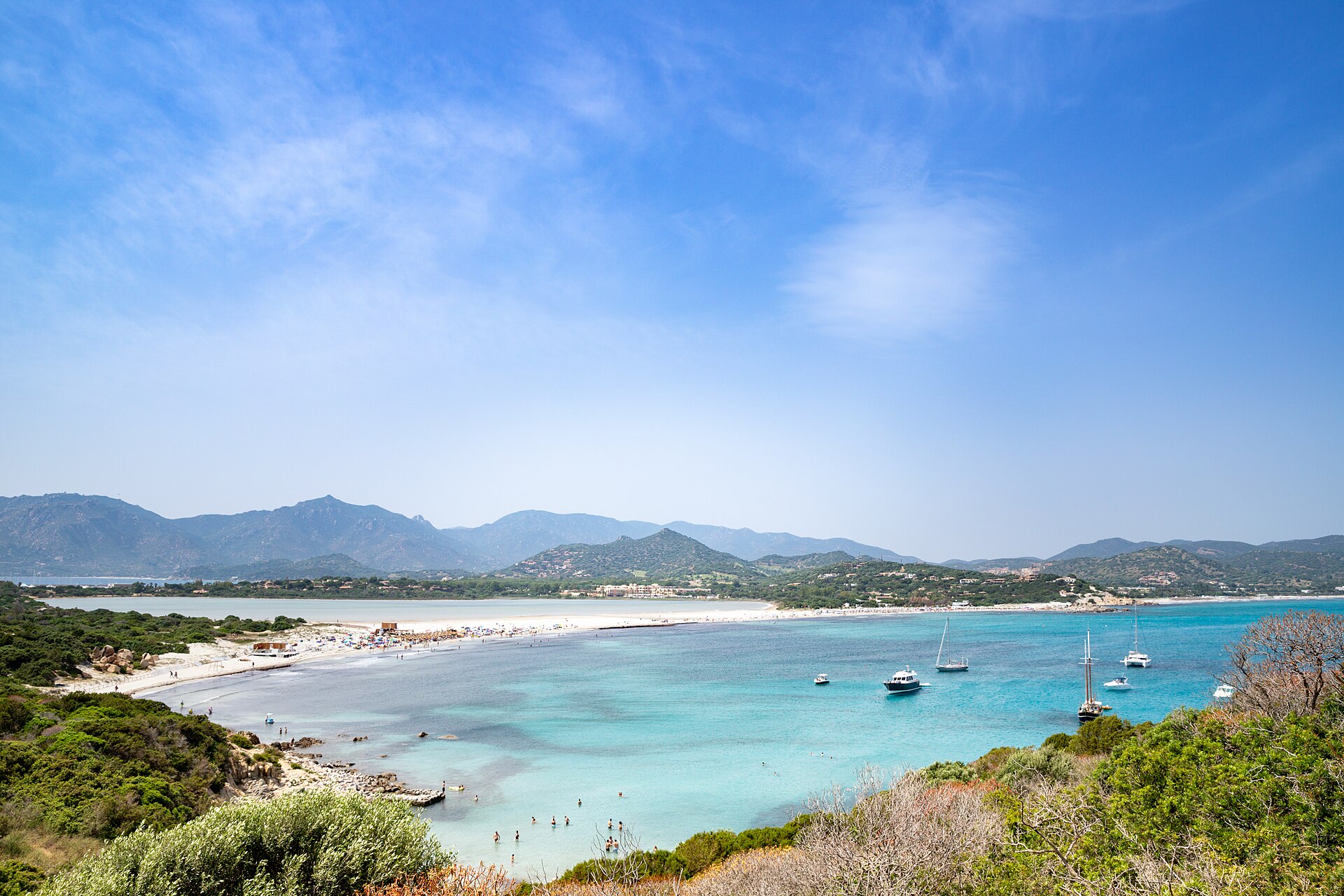
Pink granite, dunes, lagoons full of flamingos and a sea that has few rivals in the Mediterranean: what to see in Villasimius is the question on the lips of anyone dreaming of south-east Sardinia. This small town, an hour from Cagliari, is home to a Marine Protected Area, a string of picture-postcard beaches, islands, watchtowers and a Spanish fortress.
In this guide you’ll find the 12 highlights not to miss in Villasimius, the beaches one by one with tips on how to reach them, things to do, a little history, local dishes, festivals and all the practical information: how to get there, where to park, when to go and how many days to stay.
Contents
Su mari de Crabonaxa est unu prantu de lughe (“The sea of Carbonara is a cry of light”).
Folk verse from the Sarrabus
Why visit Villasimius
Villasimius lies at the south-eastern tip of Sardinia, in the province of Cagliari, about 50 km from the provincial capital. It has around 3,800 residents, a number that multiplies in summer. The town sits on a small rise, while the coastline unfolds all around it, with the promontory of Capo Carbonara marking the far edge of the Gulf of Cagliari.
The sea is protected by the Capo Carbonara Marine Protected Area, one of the most important in Italy: seagrass meadows, shoals, shipwrecks and extraordinary marine life. On land, the landscape is a mix of granite rock, Mediterranean scrub, dunes and lagoons where flamingos stop to feed.
Villasimius is a hit with families for its shallow water and fine sand, with snorkellers and divers, with photographers for its sunsets, and with anyone after a Caribbean-style sea without straying too far from Cagliari. If you’re wondering what to see in Villasimius, be prepared to pick a different bay every day.
What to see in Villasimius: the 12 highlights
1. Porto Giunco and the Notteri lagoon
The signature beach of Villasimius: a long strip of pale, coarse-grained, faintly pink sand separating the sea from the Notteri lagoon, home to pink flamingos and herons. Turquoise water on one side, lagoon on the other: a contrast like no other.
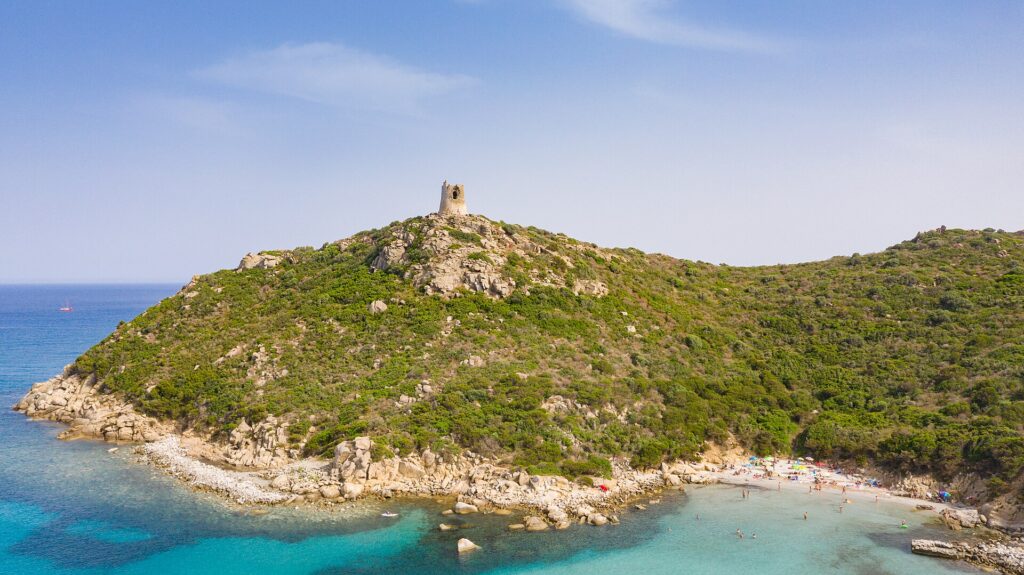
2. The Porto Giunco Tower
On the headland that closes off Porto Giunco stands a watchtower built by the Spanish in the 16th century. It’s a short walk to reach it, and from the top the view takes in the beach, the lagoon and Isola dei Cavoli. At sunset it’s one of the most photographed spots in southern Sardinia.
The path starts from the beach car park and climbs through juniper and mastic bushes: it takes around twenty minutes, but you’ll need closed shoes and water, especially in summer. Along the way there are viewpoints over the sea and the granite rocks, perfect for stopping to take a few photos.
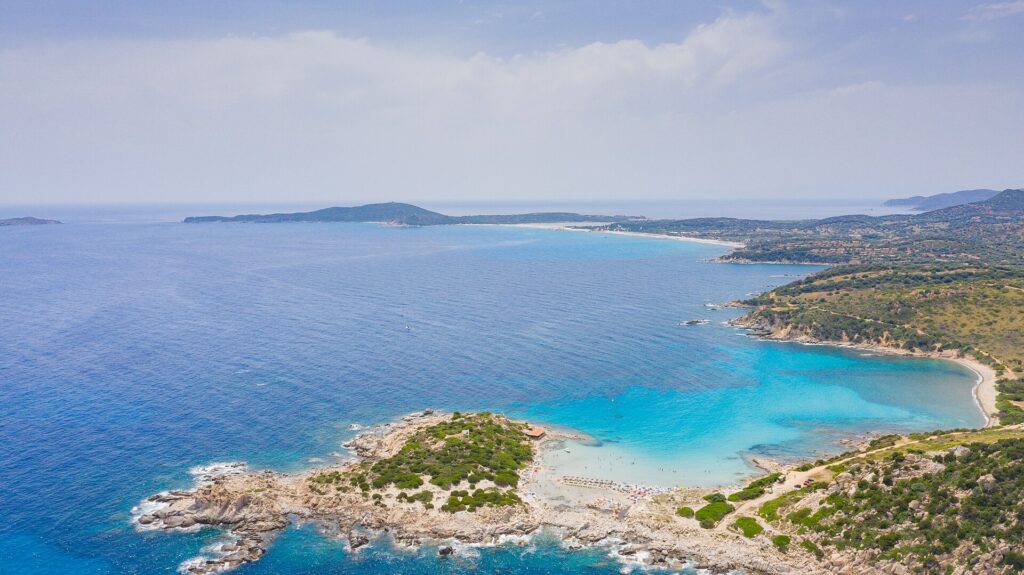
3. Punta Molentis
A slender tongue of land reaching out into the sea, with two small white-sand beaches on either side and granite rocks shaped by the wind. In summer, access is limited, with advance booking and paid parking: check the arrangements before you set off.
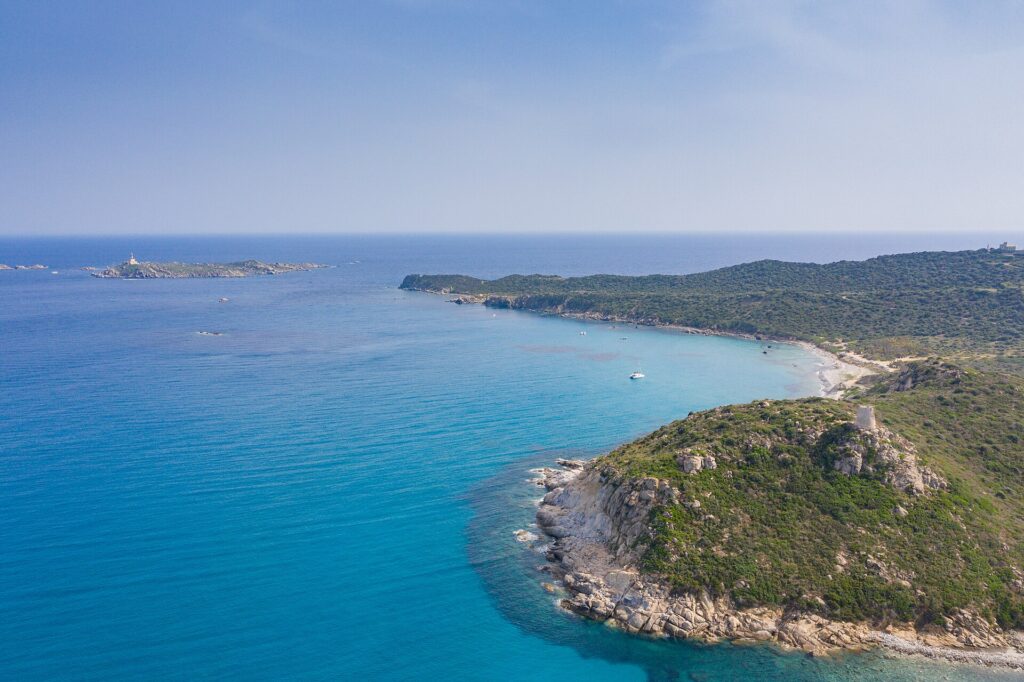
4. Capo Carbonara
This headland is the heart of the Marine Protected Area. A road leads to the military zone at its tip, while paths and coves open up along the coast. The sea here changes colour at every hour of the day, and the seabed is perfect for snorkelling.
5. Isola dei Cavoli
Facing Capo Carbonara, the island is topped by a lighthouse and surrounded by spectacular seabed. At a depth of about 10 metres lies the statue of the Madonna del Naufrago (the Madonna of the Shipwrecked), a destination for divers and the focus of a moving sea procession in July. You can reach the island on a boat trip.
6. Serpentara island
Further to the north-east, this long, narrow, uninhabited island is crowned by a Spanish tower. The waters around it are among the clearest in the Marine Protected Area and are home to groupers, white seabream and brown meagre.
7. The Fortezza Vecchia
A 17th-century Spanish fortification stands on the promontory near the harbour. Built to defend the coast from Barbary raids, it now hosts exhibitions and events and offers a lovely view over the gulf.
8. The Archaeological Museum
In the town, the museum tells the story of the area through Nuragic, Phoenician and Roman finds, and above all through objects recovered from the wrecks that sank off Capo Carbonara, including the cargo of a 15th-century Spanish ship.
9. Spiaggia del Riso
It takes its name from the grains of white and pink quartz that look like grains of rice. It’s a small bay near the harbour, ideal for a quiet swim and for snorkelling among the rocks.
10. Simius and the town centre
The beach of Simius, the closest to the town, is wide, well equipped and great for families. It’s only a few minutes from the centre, with its square and shopping streets. In the evening the town comes alive with bars, ice-cream parlours and little markets.
11. Timi Ama and Campulongu
Timi Ama is another beach overlooking a lagoon, with fine sand and shallow water. Campulongu, near the marina, is convenient and sheltered, with facilities and sailing and windsurfing schools.
12. The marina
Boat and RIB trips set off from the marina to Isola dei Cavoli, Serpentara and the coves along the coast. It’s also a pleasant place for a sunset stroll, with restaurants overlooking the boats.
The best beaches in Villasimius
Here are the beaches not to miss, with a few pointers on choosing according to the wind.
- Porto Giunco: the most famous, with the flamingo lagoon behind it.
- Punta Molentis: small and scenic, with limited access in summer.
- Simius: close to the town, well equipped and good for children.
- Timi Ama: peaceful, with fine sand and shallow water.
- Campulongu: sheltered, perfect when the mistral is blowing.
- Spiaggia del Riso: a small quartz-sand bay.
- Cala Caterina and Porto Sa Ruxi: granite coves for snorkelling.
When the mistral is blowing, choose south-facing beaches such as Simius and Campulongu; with the scirocco, Porto Giunco and Punta Molentis are better. For more ideas, read our guide to boat trips in Sardinia.
The Capo Carbonara Marine Protected Area
Established in 1998, the Marine Protected Area covers around 14,000 hectares of sea around the promontory, Isola dei Cavoli and Serpentara. It is divided into zones with different levels of protection: in some, swimming is allowed freely, while in others navigation, anchoring and fishing are regulated or banned.
Beneath the surface you’ll find meadows of Posidonia seagrass, gorgonians, colourful sponges, groupers, dentex, octopuses, moray eels and, on lucky days, dolphins and sea turtles. The seabed also holds the wrecks of ships from different eras, which are the focus of guided dives.
If you hire a boat or a RIB, find out where you’re allowed to stop and use the mooring buoys where available: they protect the Posidonia from anchors. Following the rules means this sea will stay just as beautiful for those who come after us.
Where to snorkel, and tips for the sea
All you need is a mask to discover the underwater world of the Marine Protected Area. The best spots are the rocks on either side of Porto Giunco, the rocks at Punta Molentis, the coves of Capo Carbonara and Spiaggia del Riso, where the seabed alternates between sand, rock and Posidonia just a few metres from the shore.
Enter the water from the beach, swim along the rocky shoreline and always stay close to the coast, away from boat routes. A diver’s marker buoy is compulsory if you swim away from the shore, and it’s good practice in any case. Don’t touch or take away sea urchins, starfish or shells: it’s forbidden in the Marine Protected Area and damages the ecosystem.
Useful rules for the beaches of Villasimius
- Taking away sand and shells is forbidden: regional law provides for heavy fines, and checks are carried out at the airport too.
- Posidonia on the shore is precious: it protects the beach from erosion, so leave it where it is.
- Dunes and lagoons are protected: use the boardwalks and don’t disturb the flamingos.
- No smoking or littering: several beaches have bans on smoking and single-use plastic.
- Dogs: they are allowed only in a few designated areas, so check before you go.
Villasimius out of season
From October to April Villasimius becomes a different place: quiet beaches, richer colours, lagoons full of migratory birds and days that are perfect for walking along the coast. Many venues close, but the town’s restaurants, bars and services stay open.
It’s the ideal time for hikes on the promontory, for photographing the towers at sunset and for trying sea urchins, which are harvested in winter. For more ideas, read our guide on what to do in Sardinia in November.
Things to do in Villasimius: experiences not to miss
Once you’ve found out what to see in Villasimius, choose the experiences that bring you closer to the sea and the coast.
- Boat trips to Isola dei Cavoli and Serpentara, with stops for swimming and snorkelling.
- Diving at the Madonna del Naufrago, on the shoals and the wrecks of the Marine Protected Area.
- Snorkelling in the coves of Capo Carbonara and at Spiaggia del Riso.
- Kayaking and SUP along the coast, at dawn or sunset.
- Sailing and windsurfing at Campulongu.
- Hiking on the promontory’s trails and up to the towers.
- Birdwatching at the Notteri and Timi Ama lagoons.
Experiences run by local operators, with direct contact and no commission, can be found on our page things to do in Villasimius. For more ideas on the water, read our guide to fishing tourism in Sardinia.
A brief history of Villasimius
The area was inhabited in the Nuragic age and visited by the Phoenicians and Romans, who used the coast as a landing place: the remains of a temple dedicated to Astarte and the many wrecks on the seabed bear witness to this. In the Middle Ages the area, exposed to raids from the sea, became depopulated.
The Spanish built towers and fortresses to defend the coast between the 16th and 17th centuries. The modern town was born in the 19th century under the name of Carbonara, linked to the charcoal produced in the surrounding woods; in 1862 it took the name Villasimius. Since the 1960s tourism has turned it into one of Sardinia’s best-loved seaside resorts.
What to eat in Villasimius
The cuisine combines the sea with the traditions of the Sarrabus. Dishes to try:
- sea urchins, in season, raw or with spaghetti;
- fregola with clams (fregola is a Sardinian toasted pasta) and fish soup;
- fish from the gulf, grilled or poached in a light tomato broth (all’acqua pazza);
- culurgiones (stuffed pasta parcels) and malloreddus alla campidanese (small Sardinian gnocchi with sausage ragù);
- almond sweets such as amaretti and pabassinas (shortbread-style biscuits with raisins and nuts);
- wines from southern Sardinia, such as Vermentino and Nuragus.
You’ll find restaurants and pizzerias on our page where to eat in Villasimius, and an overview of the island’s cuisine in our guide to traditional Sardinian dishes.
Festivals and events in Villasimius
- Madonna del Naufrago (July): a procession of boats accompanies the statue of the Madonna to Isola dei Cavoli, where divers lay a wreath of flowers on the submerged statue.
- Festa di Santa Maria (summer): the patron saint’s festival, with a procession, music and fireworks.
- Summer in Villasimius: concerts, markets and evenings in the square from June to September.
Villasimius in 1, 2 or 3 days
In one day: morning at Porto Giunco and a climb up to the tower, lunch in town, afternoon at Simius or Riso, sunset at the harbour.
If you’re travelling with small children, choose Simius or Timi Ama in the morning, when the sea is calmer, and leave Porto Giunco for the afternoon, when the car parks empty and the light over the lagoon turns magical. Bring a cool bag and plenty of water: on some beaches the kiosks are a long way off.
In two days: add a boat trip to Isola dei Cavoli and Serpentara, with snorkelling.
In three days: spend the third day at Punta Molentis, the Fortezza Vecchia and the museum. With a week you can add Costa Rei, Castiadas and Cagliari.
Around Villasimius
- Costa Rei (about 30 minutes): a very long white-sand beach.
- Castiadas (about 25 minutes): the old penal colony and the coves of Cala Pira and Cala Sinzias.
- Cagliari (about 1 hour): the Castello district, Poetto and the Sella del Diavolo.
- Parco dei Sette Fratelli (about 45 minutes): woodland, Sardinian deer and walking trails.
Practical information: getting there, parking, when to go
How to get to Villasimius
Cagliari-Elmas airport is about 60 km away: it takes roughly an hour by car. The coast road from Quartu Sant’Elena is scenic but winding; the inland road is quicker. Cagliari port, with ferries from Civitavecchia, Naples and Palermo, is about 50 minutes away. In summer there are buses from Cagliari.
Getting around and parking
To get around the beaches you’ll need a car or a scooter. In summer almost all beach car parks are paid, and Punta Molentis requires a booking. Arrive early and bring water and a parasol: there is little natural shade.
Where to stay
The town is handy if you want restaurants and services within walking distance. The areas near the harbour and Campulongu are ideal for boat trips. If you’re after peace and quiet, you could choose the countryside towards Castiadas.
When to go
The best time is from May to October. June and September offer warm sea and fewer crowds; July and August are the liveliest and busiest months. In spring and autumn the beaches are almost deserted and perfect for long walks.
For official information, see the website of the Comune di Villasimius (the town council) and that of the Capo Carbonara Marine Protected Area.
Frequently asked questions about what to see in Villasimius
What is the most beautiful beach in Villasimius?
Porto Giunco is the most famous; Punta Molentis the most scenic; Simius and Campulongu the most convenient for families.
Do I need to book for Punta Molentis?
In high season access is limited, with advance booking and paid parking. The rules may change, so check before you set off.
Is Villasimius suitable for children?
Yes: many beaches have shallow water and fine sand, and boat trips are a big hit with little ones. You’ll find more ideas in our guide to Sardinia with children.
How many days do you need to visit Villasimius?
At least three days for the main beaches and a boat trip. With a week you can explore the whole south-east, as far as Costa Rei and Cagliari.
Villasimius, best enjoyed with those who know it
Now you know what to see in Villasimius: Porto Giunco and its flamingos, Punta Molentis, Capo Carbonara, Isola dei Cavoli and a sea that looks painted. Whether you come for a week in the sun or a spring weekend, you’ll always find a quiet bay, a seabed to explore or a tower from which to watch the sunset. To really experience it, rely on the people who know it best: choose an experience from those offered by local operators and contact them directly. Ajò, Sardinia is waiting for you.
