S’Ardia of San Costantino in Sedilo 2027
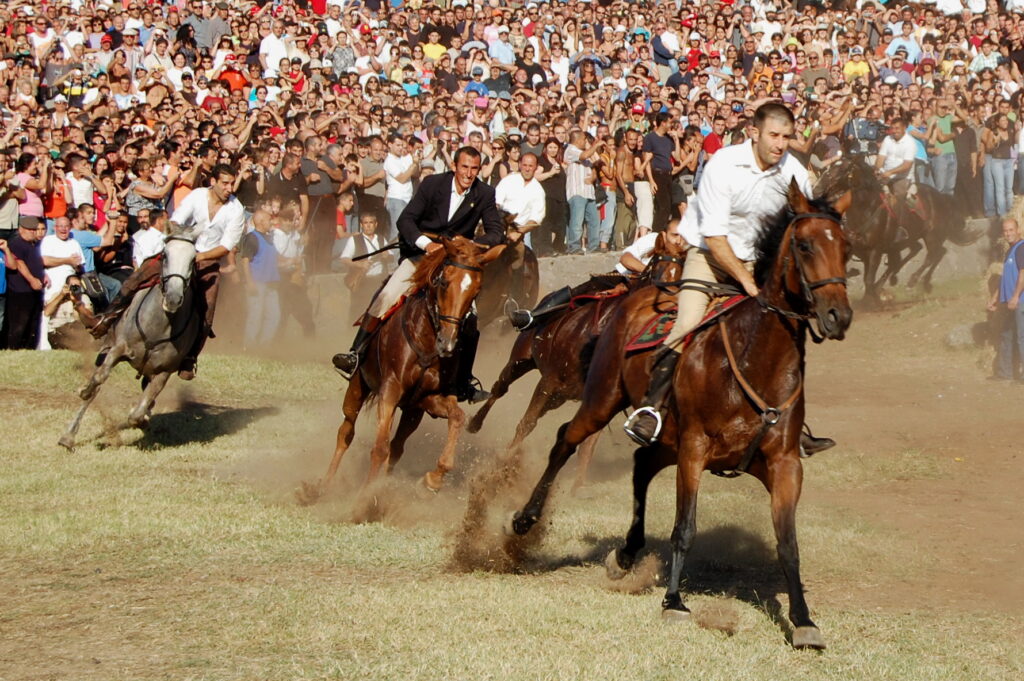
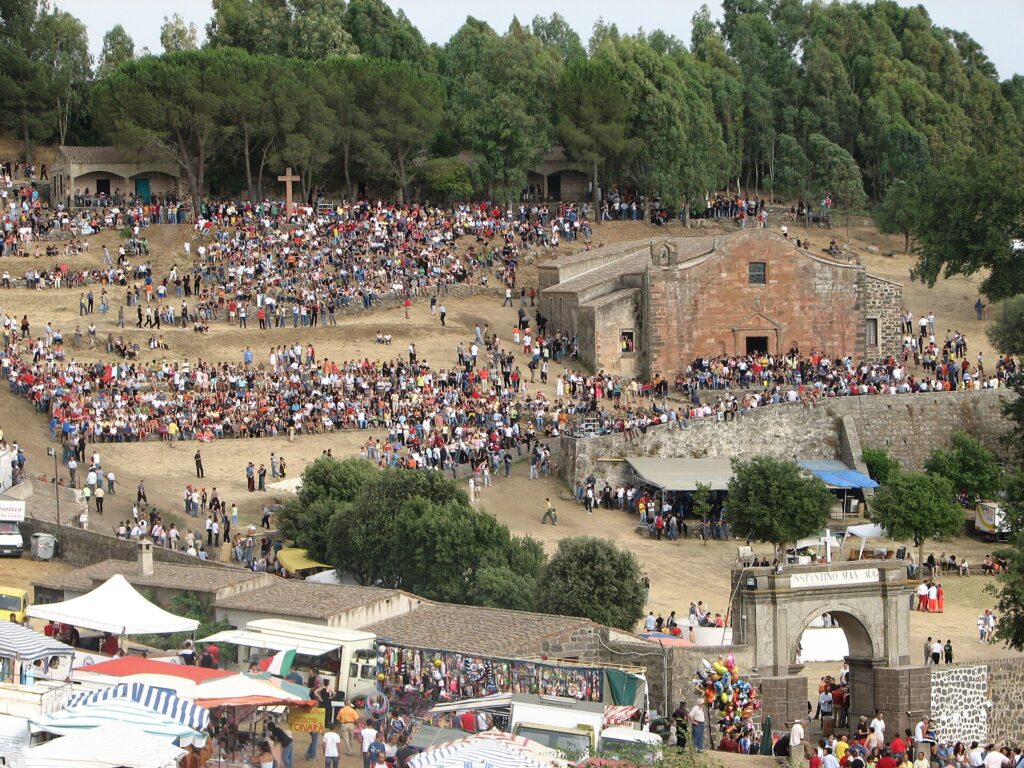
S’Ardia of San Costantino is Sardinia’s wildest horse race: hundreds of riders hurl themselves at full gallop down a hillside, amid gunshots and clouds of dust, to defend the saint’s banner. It takes place in Sedilo, a village in the Guilcer area of central-western Sardinia (province of Oristano), around the sanctuary of San Costantino overlooking Lake Omodeo. In 2027 the race is run at sunset on 6 July and again at dawn on 7 July.
History and meaning of S’Ardia
In Sardinian, ardia means “guard” or “escort”. The race re-enacts the Battle of the Milvian Bridge in 312 AD, when Emperor Constantine defeated Maxentius after seeing the sign of the cross in the sky. The rider who leads the race represents Constantine and his army; the riders chasing him are Maxentius’s pagan troops. The leader must never be overtaken – that would mean the defeat of the Christian faith.
In Sedilo, Constantine is fondly called Santu Antinu. His cult here is ancient and popular: the Catholic Church never added him to its calendar of saints, but for the people of the Guilcer he is a powerful protector to whom vows are made. The sanctuary is filled with ex-voto offerings, and many riders take part in the Ardia to fulfil a personal promise to the saint.
The sanctuary of San Costantino has very old origins; the present church dates from the 16th century, in Catalan Gothic style with a red trachyte façade, and was remodelled in the 18th century. Around it stand the cumbessias, little houses that once lodged pilgrims during the novena.
What happens at the Ardia: the races of 6 and 7 July
Sa prima pandela and the escorts
The parish priest entrusts the saint’s banner, sa pandela, to the rider who will lead the race: sa prima pandela. He in turn chooses the second and third banner-bearers and their escorts, riders in white shirts whose job is to protect the banners and keep the chasers at bay. Being chosen is a great honour and a heavy responsibility.
The charge down from Su Frontigheddu
On the afternoon of 6 July the riders gather in the village in front of the priest’s house and ride slowly up to Su Frontigheddu, a rocky rise above the sanctuary valley where spectators also crowd. Then, without warning, sa prima pandela bursts into a gallop and everyone charges after him down the slope, amid blank shots fired by the riflemen and swirling dust. The race passes through the narrow stone arch leading into the sanctuary grounds – one of the most spectacular and dangerous points.
The laps around the sanctuary
At the church, the riders circle the sanctuary seven times, then race off again towards sa muredda, a round walled clearing with a cross at its centre. The whole ritual is repeated at dawn on 7 July, and in the afternoon of that day there’s a procession in honour of the saint. On the second Sunday after the Ardia, the same route is walked on foot.
What to eat in Sedilo and the Guilcer
During the festival Sedilo eats like any big Sardinian village feast: roast meats, sausage, pecorino cheeses, crisp pane carasau flatbread and almond sweets. The Guilcer borders the Montiferru hills, known for top-quality produce: casizolu, a stretched-curd cow’s milk cheese, beef from the local red cattle and highly prized olive oil. All great souvenirs, along with a local wine or a bottle of Vernaccia di Oristano.
Things to see around Sedilo
The countryside around Sedilo is packed with archaeology. On the shores of Lake Omodeo lies the Nuragic complex of Iloi, with a multi-towered nuraghe (a Bronze Age stone tower), a village and two “giants’ tombs”. Nearby are the sacred spring of Puntanarcu and the Ispiluncas necropolis, with around thirty domus de janas – rock-cut tombs from the pre-Nuragic era. Lake Omodeo, Sardinia’s largest artificial lake, is lovely for walks and bike rides in the cool of the evening.
In the neighbouring villages, it’s worth a detour to see the Nuraghe Losa at Abbasanta, one of the best preserved on the island, the Antonio Gramsci house museum in Ghilarza, the Santa Sabina complex at Silanus with its nuraghe and Byzantine chapel, the Roman baths of Fordongianus and the sacred well of Santa Cristina at Paulilatino.
How to get to Sedilo and practical tips
Sedilo lies in the heart of the island, close to the main road linking Abbasanta with Nuoro and Olbia. From Oristano it’s about 40 minutes by car; from Cagliari, Alghero or Olbia airports, roughly an hour and a half or a little more. Ferries arrive at Olbia, Porto Torres and Cagliari. Without a car the village is hard to reach, so renting one is the best option.
- Safety: the Ardia is beautiful but genuinely dangerous. Always stay in the public areas, follow the stewards’ instructions and never approach the horses’ route. With small children, pick a raised spot well away from the track.
- Timing: arrive early to find a place on Su Frontigheddu; for the dawn race on 7 July you need to be there while it’s still dark. Check exact times with the parish and the Comune of Sedilo.
- What to wear: July is very hot and dusty – bring a hat, water, closed shoes and a scarf for your mouth and nose.
- Where to stay: beds in the village are few; consider Ghilarza, Abbasanta or Oristano.
Ardia of Sedilo FAQ
When is the Ardia of Sedilo in 2027?
At sunset on 6 July 2027 and at dawn on 7 July 2027, around the sanctuary of San Costantino.
What does “Ardia” mean?
It’s Sardinian for “guard” or “escort”: the riders escort the saint’s banner, which stands for Constantine’s army.
Who chooses the leader of the race?
The parish priest of Sedilo hands the banner to sa prima pandela, who then chooses the second and third banner-bearers and the escorts.