Fiore Sardo PDO cheese
Price on request Discover
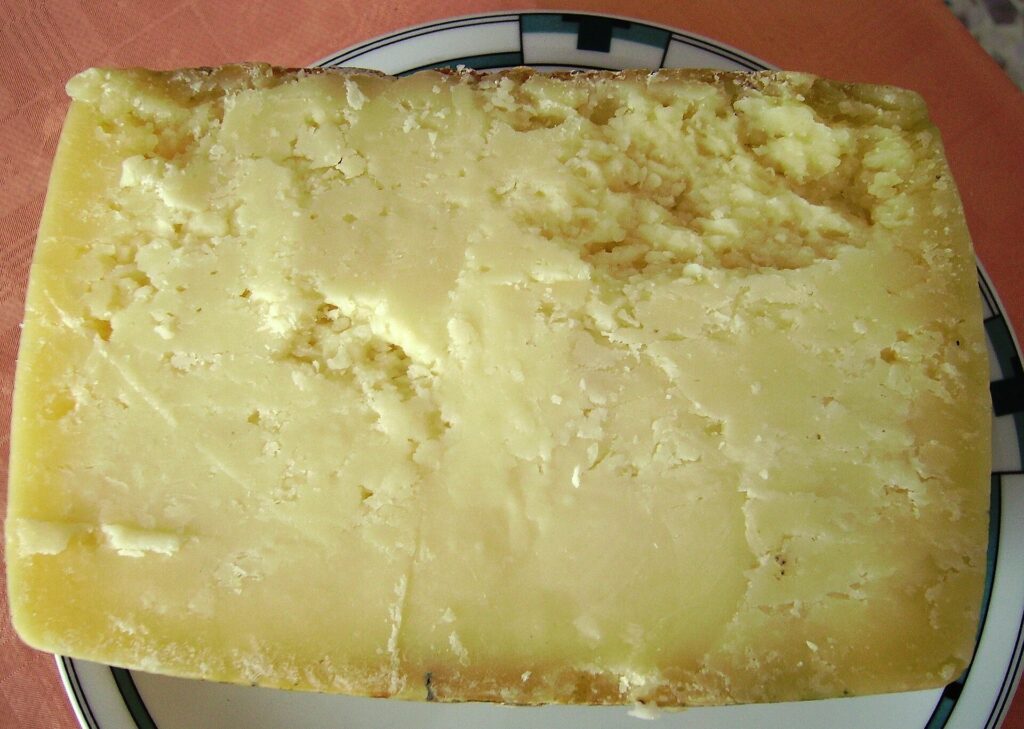
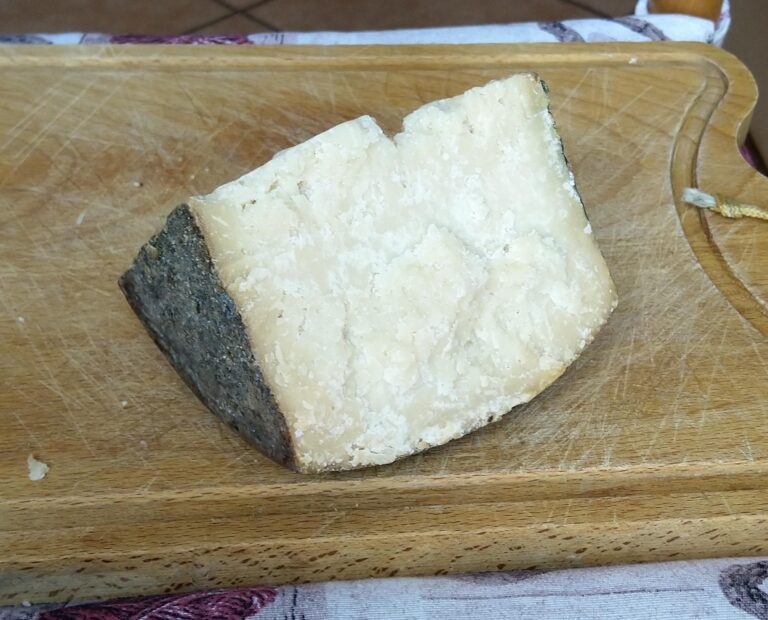
In Sardinia, pecorino is not just any cheese: it is the milk of our sheep, the work of shepherds and cheesemakers, the taste of home. Among the many cheeses made on the island, Pecorino Sardo PDO has two personalities: dolce (mild), fresh and delicate, to eat in slices; and maturo (aged), bold and aromatic, at its best with a good red wine or grated over pasta.
Sheep farming in Sardinia goes back to the Nuragic age. The first precise records of the island’s cheeses date to the late 18th century, which mention “white”, “fine red” and “smoked” cheeses – considered the ancestors of today’s Pecorino Sardo. Between the late 1800s and early 1900s, cheesemaking modernised with thermometers, milk filtering, liquid rennet, lactic starters and the semi-cooking of the curd. The result was a more consistent pecorino, distinct from both the shepherds’ Fiore Sardo and Pecorino Romano, yet deeply tied to Sardinian pastures.
Pecorino Sardo is made from whole sheep’s milk from Sardinia, which may be thermised or pasteurised. The milk is curdled with calf rennet at about 35-39 °C; the curd is cut to the size of a hazelnut (dolce) or a grain of corn (maturo), semi-cooked, moulded into cylinders, pressed and salted.
Pecorino Sardo received its designation of origin in 1991 and became an EU PDO in 1996 (Regulation EC 1263/1996). The production area is all of Sardinia. The island has three PDO cheeses: Pecorino Sardo, Fiore Sardo and Pecorino Romano, of which Sardinia is the main producer.
Pecorino Sardo PDO is made all over the island, from large dairies in the great pastoral areas to small village cooperatives. You will find it in shops, markets, agriturismi and trattorias from north to south. Many farms and dairies welcome visitors to see how the milk is worked and to taste the cheese – ideally side by side with Fiore Sardo and Pecorino Romano. Always ask to try both dolce and maturo: they feel like two different cheeses.
Pecorino Sardo is semi-cooked, uses calf rennet and milk that may be heat-treated. Fiore Sardo is made from raw milk with lamb or kid rennet, without cooking the curd, and has a distinctive bulging shape.
Dolce for 20 to 60 days, maturo for more than two months. The longer it ages, the firmer and more flavourful it becomes.
The production rules forbid freezing the wheels. At home, keep it in the fridge wrapped in food paper and eat it within a few days of cutting.
Do you run activities in Sardinia?
Get your own page on Ajò Sardegna: free until 31 May 2027, no commissions, with customer requests coming straight to you. If you like, we prepare the page for you.
Hi!
Can I help you?
Lia is an AI-based virtual assistant and can make mistakes: always check with the operator. Please don't share personal data. Privacy