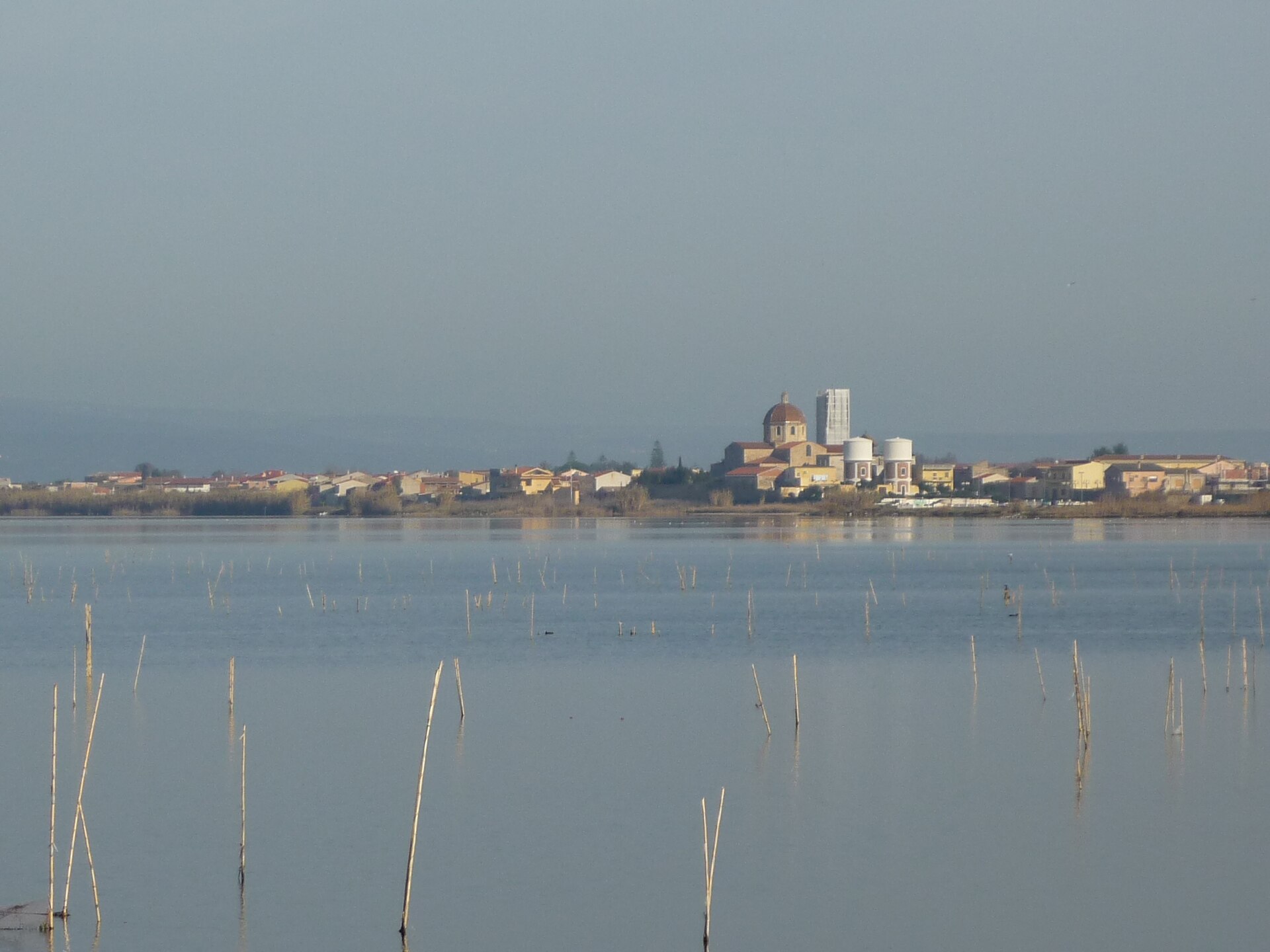
A Phoenician city overlooking the sea, beaches made of quartz grains, a vast lagoon and the oldest stone giants in the Mediterranean: the question of what to see in Cabras opens the door to the Sinis peninsula, on Sardinia’s west coast. Archaeology, nature and sea all come together here within a few kilometres.
In this guide you’ll find the 12 unmissable stops in Cabras, a rundown of the beaches, the experiences worth having, a little history, local specialities such as bottarga (cured mullet roe), the festivals and all the practical information: how to get there, where to park, when to go and how many days to stay.
Contents
Chini no hat bistu Tharros, no hat bistu nudda (“Whoever hasn’t seen Tharros has seen nothing”).
Popular saying from the Sinis
Why visit Cabras
Cabras lies in central-western Sardinia, in the province of Oristano, just a few kilometres from the provincial capital. The town sits on the shore of the lagoon of the same name, one of the largest wetlands in Europe, and its territory takes in almost the whole of the Sinis peninsula, a flat, luminous strip of land stretching out into the sea towards Capo San Marco.
The sea here is protected by the Penisola del Sinis – Isola di Mal di Ventre Marine Protected Area: Posidonia seagrass meadows, rocky outcrops, ancient wrecks and clear water that turns Caribbean shades in summer. On land, dunes, farmland, reed beds and lagoons alternate, home to flamingos, herons and black-winged stilts.
Cabras appeals to anyone who loves ancient history, to those looking for beaches unlike any other, to surfers chasing the mistral, and to travellers who want an authentic Sardinia, far from the crowds of the north-east coast. If you’re wondering what to see in Cabras, be prepared to go from the columns of a Phoenician city to a beach of white and pink quartz in a single day.
What to see in Cabras: the 12 unmissable stops
1. The archaeological site of Tharros
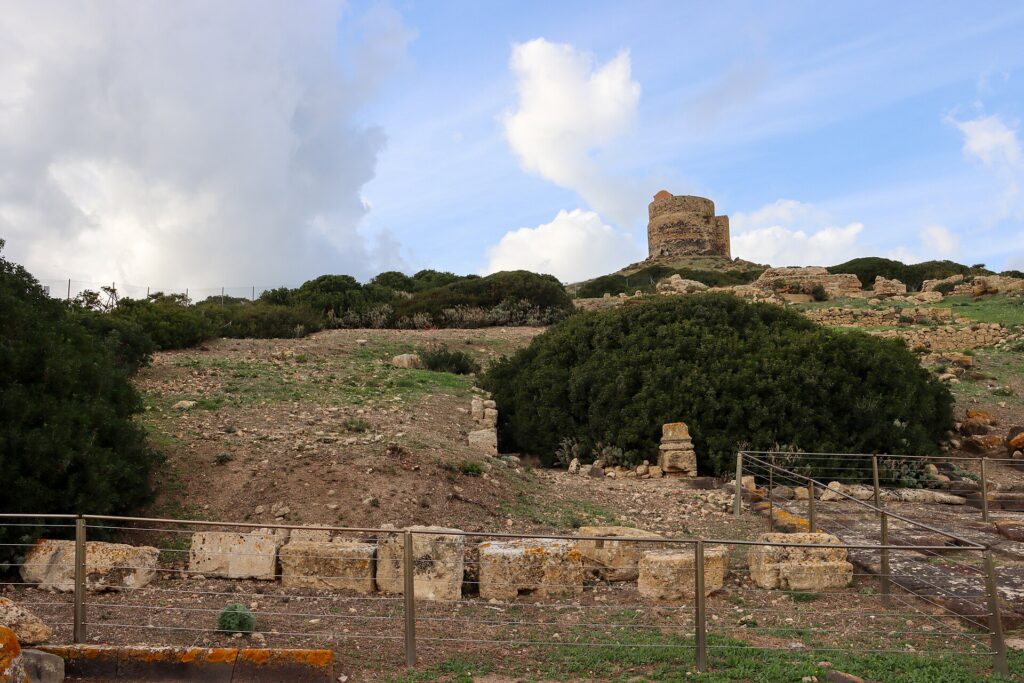
This is the stop that justifies the trip on its own. Tharros was founded by the Phoenicians in the 8th century BC on a slender tongue of land jutting into the Gulf of Oristano. It later became an important Punic centre and finally a Roman city. You walk along basalt-paved streets, past residential quarters, workshops, baths, an aqueduct and the remains of temples.
The symbol of the site is the pair of Corinthian columns that have been raised upright again, standing out against the sea: at sunset the view is unforgettable. On the hill of Su Murru Mannu you’ll find the tophet, the Phoenician-Punic sacred area, and the remains of a nuragic village that predates the city.
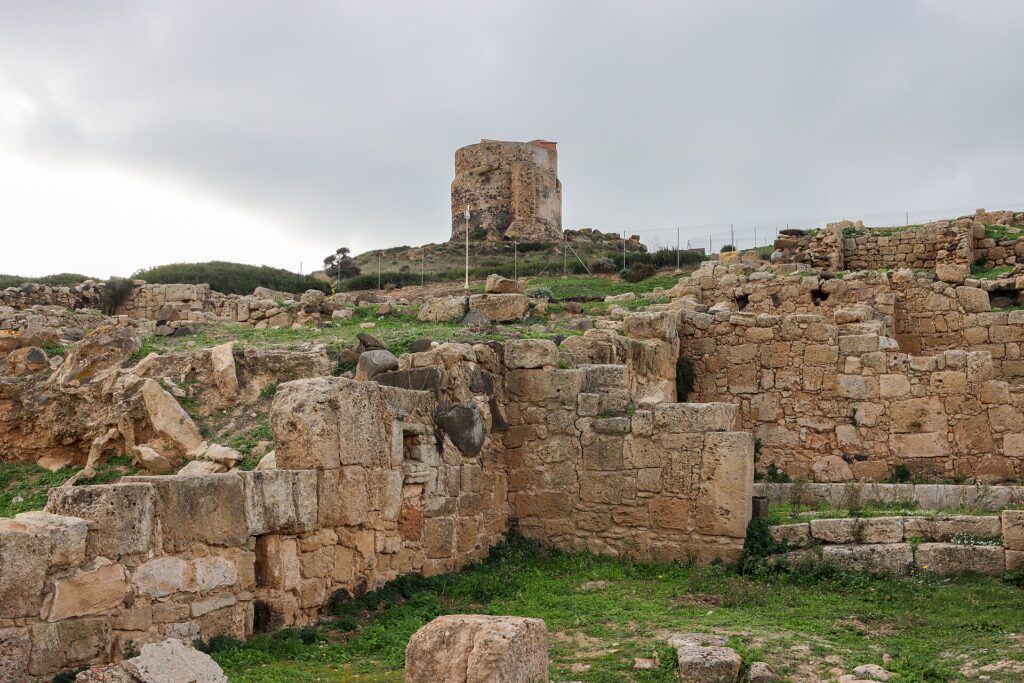
Allow at least two hours for the visit, and bring comfortable shoes, a hat and water: the summer sun is fierce and there’s very little shade. There is an admission charge, and a combined ticket with Cabras’s civic museum is often available.
2. The Torre di San Giovanni and Capo San Marco
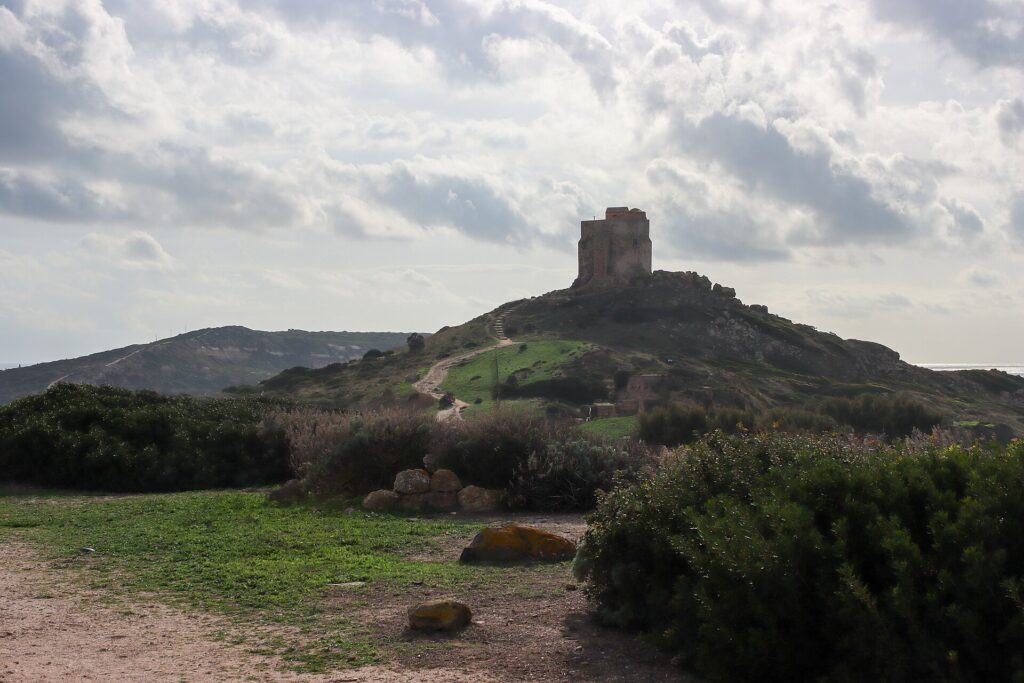
Above Tharros rises the Torre di San Giovanni, built by the Spanish between the 16th and 17th centuries to defend the coast from pirates. From the top the view sweeps across the whole Gulf of Oristano, the excavations and the headland of Capo San Marco, where a path leads to the lighthouse through cliffs, scrub and wind.
3. The church of San Giovanni di Sinis
At the entrance to the village of San Giovanni stands one of the oldest churches in Sardinia. The earliest parts date from the Byzantine era, between the 5th and 6th centuries, and the building was extended in the Middle Ages. The interior is bare and intimate, with sandstone walls and a dome that filters a soft light: step inside quietly and let it surprise you.
4. The village of San Salvatore di Sinis
A small village of cumbessias, the low cottages that once housed pilgrims during the novenas (nine-day periods of prayer), gathered around a country church. Beneath the church lies a hypogeal sanctuary, possibly born as a place of water worship in the nuragic age and later used in Roman and Christian times, with graffiti and inscriptions on its walls.
In the 1960s its dusty little squares served as the set for several spaghetti westerns: even today, when the village is deserted, it feels like a village in Mexico. It comes to life above all in late summer, with the festival and the barefoot race of the Scalzi.
5. The Museo Civico Giovanni Marongiu and the Giants of Mont’e Prama
Cabras’s museum houses finds from Tharros, the Sinis and the seabed, but above all some of the statues of the Giants of Mont’e Prama: boxers, archers and warriors carved from sandstone in the nuragic age, discovered from 1974 onwards in a necropolis in the Sinis. They are among the oldest free-standing sculptures in the western Mediterranean.
Seeing them up close, with their distinctive double-circle eyes, is a unique experience. Other Giants are on display at the Museo Archeologico Nazionale in Cagliari. To understand the world that created them, read our guide to the most beautiful nuraghi in Sardinia.
6. The Cabras lagoon and the fassonis
The lagoon that embraces the town covers over 2,000 hectares and is teeming with fish and birdlife. For centuries fishermen have worked it in fassonis, boats made by weaving marsh reeds together, a technique that goes back to ancient times. Along the banks you can spot flamingos, herons, marsh harriers and coots.
At dawn and at sunset the reflections on the water create a magical atmosphere: bring binoculars and pick one of the viewing points along the dirt tracks that skirt the lagoon.
7. The centre of Cabras and the church of Santa Maria
The town has a simple, lively centre, with low houses, courtyards and the large church of Santa Maria Assunta, built on the remains of an ancient castle of the Judges. Stroll through in the late afternoon, when the fishermen come home and the fishmongers display grey mullet, eels and bottarga.
8. The island of Mal di Ventre
Out to sea, about eight kilometres from the coast, the island of Mal di Ventre is a flat expanse of granite and low scrub, at the heart of the marine reserve. Its name is said to come from the Sardinian “malu ‘entu”, meaning bad wind: when the mistral blows, the surrounding sea gets properly rough. On calm days it’s an outstanding spot for snorkelling and diving, reachable only by boat.
9. The Scoglio del Catalano
A little south of Mal di Ventre, the Scoglio del Catalano rises out of the water, a lone spur of volcanic rock in the middle of the sea. Its seabed, rich in fish, gorgonians and sponges, is among the most prized by divers in the Oristano area.
10. Is Arutas, the quartz beach
Cabras’s most famous beach isn’t made of sand at all, but of tiny, polished quartz grains in white, pink and green, which slip through your fingers like rice. The water is an incredible shade of blue and the seabed drops away quickly. Remember that taking away even a single grain is forbidden: the fines are hefty, and the beach needs protecting.
11. Mari Ermi and Maimoni
To the north and south of Is Arutas stretch two more beaches of quartz and sand: Mari Ermi, wilder and windier, loved by surfers, and Maimoni, wide and backed by dunes, ideal for long walks. Both have car parks nearby and, in summer, a few beach kiosks.
12. The beach at San Giovanni di Sinis
Between the village and Tharros, San Giovanni beach is the easiest for families: pale sand, shallow water in the sheltered part and facilities close at hand. From here you can see the columns of Tharros and the Spanish tower, a perfect backdrop for a day of sea and history.
The beaches of Cabras: which one to choose
The beaches of the Sinis face west and are exposed to the mistral: when it blows hard, it’s best to head to the more sheltered side of the Gulf of Oristano. Here’s how to get your bearings:
- Is Arutas: the most spectacular, with quartz grains and crystal-clear water; paid parking in summer.
- Mari Ermi: wild and windy, perfect for surfing and windsurfing.
- Maimoni: wide, with dunes and an equipped stretch; suits anyone who wants space.
- San Giovanni di Sinis: the most convenient, with facilities and shallow water, close to Tharros.
- Funtana Meiga: small coves among the rocks on the gulf side, lovely on mistral days.
- Sa Mesa Longa and Su Pallosu: in the neighbouring municipality of San Vero Milis, excellent for snorkelling.
To see the coast from the water and reach Mal di Ventre, consider a boat trip: you’ll find plenty of ideas in our guide to boat trips in Sardinia.
Nature and birdwatching in the Sinis
Besides the Cabras lagoon, the peninsula is home to a unique system of lagoons: Mistras, Sale Porcus, Is Benas and Pauli Murtas. In winter they host thousands of migratory birds, while in spring and summer pink flamingos colour the shallow waters. Many areas can be reached by bike along flat gravel tracks.
The marine reserve has precise rules on navigation, anchoring and fishing, which vary by zone. Before heading out by kayak or boat, check the marine area’s official website and respect the restrictions: it’s partly thanks to these rules that the sea of the Sinis is so beautiful.
Things to do in Cabras: experiences to enjoy
Once you’ve decided what to see in Cabras, choose the experiences that suit you:
- Boat trips to Mal di Ventre and the Catalano, with stops for swimming and snorkelling.
- Diving in the marine reserve, among wrecks, rocks and Posidonia meadows.
- Surfing, windsurfing and kitesurfing on mistral days, especially at Mari Ermi and Putzu Idu.
- Fishing tourism (pescaturismo) with local fishermen, to spend a working day at sea; read our guide to fishing tourism in Sardinia.
- Guided visits to Tharros and the museum, to really understand the history of the Sinis.
- Cycling and birdwatching along the lagoons and gravel roads of the peninsula.
Experiences offered by local operators, who you can contact directly and without commission, are on the page things to do in Cabras.
A short history of Cabras
The Sinis has been inhabited for thousands of years: Neolithic traces, nuraghi, villages and the necropolis of Mont’e Prama bear witness to a very ancient human presence. In the 8th century BC the Phoenicians founded Tharros, which under the Carthaginians became one of the richest ports on the island and, in Roman times, an important centre connected to Sardinia’s major roads.
In the early Middle Ages Tharros was the capital of the Judgedom of Arborea, until around the year 1000, when its inhabitants moved inland, where Oristano was born. Cabras grew as a village of fishermen and farmers tied to the lagoon, which for centuries belonged to feudal lords and only passed to the fishermen in the 20th century. The discovery of the Giants in the 1970s put the Sinis back at the centre of Mediterranean archaeology.
What to eat and drink in Cabras
The cooking of Cabras comes from the lagoon and the sea. Be sure to try:
- mullet bottarga, the signature product, grated over pasta or sliced and served with olive oil and celery;
- merca, boiled mullet preserved in salt and wrapped in marsh grasses;
- roast mullet and eels, stewed or cooked on the spit;
- spaghetti with clams and the fresh fish of the Sinis;
- almond sweets and the pirichittus of the Oristano tradition;
- Vernaccia di Oristano, an amber-coloured wine for sipping, made in the nearby Tirso valley.
You’ll find restaurants and trattorias on the page where to eat in Cabras. To get to know the island’s cuisine, read our guide to traditional Sardinian dishes.
Festivals and events in Cabras
- Corsa degli Scalzi (the Barefoot Race): in late summer, hundreds of young people dressed in white run barefoot for about seven kilometres carrying the statue of San Salvatore from the town to the village in the Sinis, and then back again. It’s one of the most moving festivals in Sardinia.
- Holy Week: processions and rituals of the confraternities through the streets of the centre.
- Festa di Santa Maria Assunta: in August, with religious celebrations and festivities in town.
- Festa di San Giovanni: in June, in the village of San Giovanni di Sinis.
Dates change every year: always check the up-to-date calendar before you travel.
Cabras in 1, 2 or 3 days
In one day: spend the morning at Tharros and the Torre di San Giovanni, have lunch with some bottarga, then head to Is Arutas in the afternoon and catch the sunset at San Giovanni di Sinis.
In two days: add the museum with the Giants of Mont’e Prama, the village of San Salvatore and a bike ride along the lagoon.
In three days: devote a day to the sea with a boat trip to Mal di Ventre and visits to the beaches of Mari Ermi and Maimoni. With more time, explore Oristano, the Montiferru and the coast as far as Bosa.
Around Cabras
- Oristano (about 10 minutes): the historic centre, the Torre di Mariano and the Carnival Sartiglia.
- Santa Giusta (about 20 minutes): the Romanesque basilica and the lagoon.
- Putzu Idu and San Vero Milis (about 20 minutes): beaches, lagoons and surf spots.
- The Montiferru (about 40 minutes): woods, waterfalls and stone villages such as Santu Lussurgiu.
- Bosa (about 1 hour): the colourful town on the river Temo; read our guide what to see in Bosa.
Practical information: getting there, parking, when to go
How to get to Cabras
The most convenient airport is Cagliari Elmas, about 100 km away: by car it takes just over an hour along the SS 131. From Alghero it takes about an hour and a half, and from Olbia about two hours. The nearest railway station is Oristano, with connections to Cagliari and Sassari; from there, regular buses run to Cabras and, in summer, to the beaches of the Sinis.
Getting around and parking
To explore the peninsula you’ll need a car or a bike. In summer the car parks at the main beaches, such as Is Arutas and San Giovanni di Sinis, are paid and fill up by mid-morning. Tharros has a car park near the entrance. The roads are flat and also suit anyone travelling by bike.
Where to stay
The town of Cabras is handy for restaurants and services. San Giovanni di Sinis is ideal if you want the sea on your doorstep. Agriturismi (farm stays) and B&Bs in the Sinis countryside offer peace and quiet and beautiful sunsets, while Oristano is a good base if you also want to explore the interior.
When to go
The best time for the sea is from May to October. Spring and autumn are perfect for Tharros, the museum and birdwatching, with milder temperatures and fewer people. Winter, with its storm surges and the mistral, brings wild landscapes and days that are ideal for surfing.
For official information, visit the website of the Comune di Cabras and that of the Sinis Marine Protected Area.
Frequently asked questions about visiting Cabras
What is the most beautiful beach in Cabras?
Is Arutas is the most famous, thanks to its quartz grains and crystal-clear water. Mari Ermi is the wildest, and San Giovanni di Sinis is the easiest for anyone travelling with children.
How long does it take to visit Tharros?
At least two hours for the excavations and the tower. If you add the civic museum with the Giants of Mont’e Prama, allow half a day.
Can you take sand away from Is Arutas?
No: it is forbidden to take sand, pebbles and shells from the beaches of Sardinia, and checks are frequent. Leave the beach as you found it, so it stays beautiful for everyone.
Is Cabras suitable for families?
Yes: San Giovanni di Sinis has shallow water and facilities, Tharros and the museum fascinate children, and the lagoon with its flamingos is a small adventure in itself. You’ll find more ideas in our guide to Sardinia with kids.
How many days do you need to visit Cabras?
Two days are enough for Tharros, the museum and the main beaches. With three or four days you can add a boat trip and the surrounding Oristano area.
Cabras, best enjoyed with the people who live here
Now you know what to see in Cabras: Tharros and its columns by the sea, the Giants of Mont’e Prama, the village of San Salvatore, the flamingo lagoon and the quartz beaches of the Sinis. It’s a land where history stretches back almost three thousand years and the sea changes colour with every hour: in the morning you can wander among Phoenician ruins and in the evening taste bottarga as the sun sinks behind Mal di Ventre. To really experience it, choose one of the experiences offered by local operators and contact them directly, with no intermediaries. Ajò, Sardinia awaits.
