Autunno in Barbagia in Mamoiada 2026: Cortes Apertas
Price on request Discover
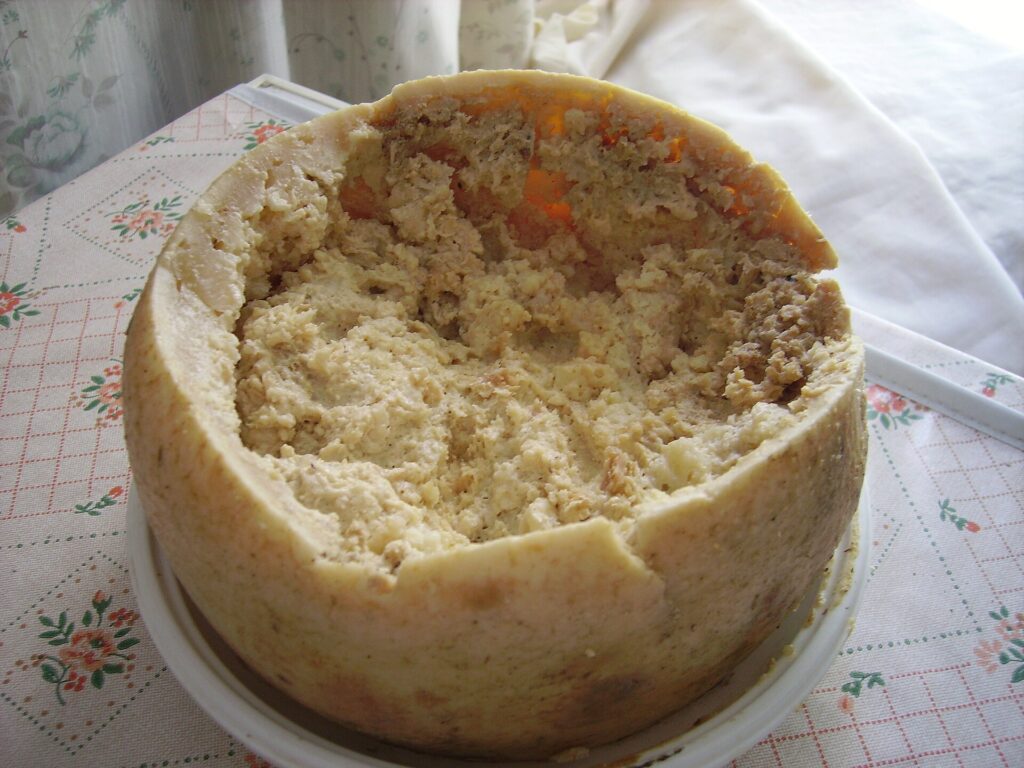
No Sardinian cheese gets people talking quite like casu marzu. Islanders also call it casu frazigu or casu martzu, and every village seems to have its own name for it, but they all mean roughly the same thing: “rotten cheese”. It is a sheep’s milk pecorino that ripens thanks to the larvae of the cheese fly, turning into a soft, sharp, intensely flavoured cream. For many Sardinians it isn’t a party trick for tourists but a memory of family, sheepfolds and long summer meals. Here is the honest story, including the rules that surround it.
Casu marzu comes straight out of shepherding life. In the island’s interior, summer heat meant some wheels of pecorino were inevitably reached by the cheese fly (Piophila casei). Rather than throw them away, shepherds learned to guide the process, and a wheel that looked lost became a delicacy to share with close friends. It is still mostly a home-made affair: small batches, made in the warm months and eaten together. Similar cheeses exist in Corsica (casgiu merzu) and other Italian regions, but the Sardinian one is by far the most famous.
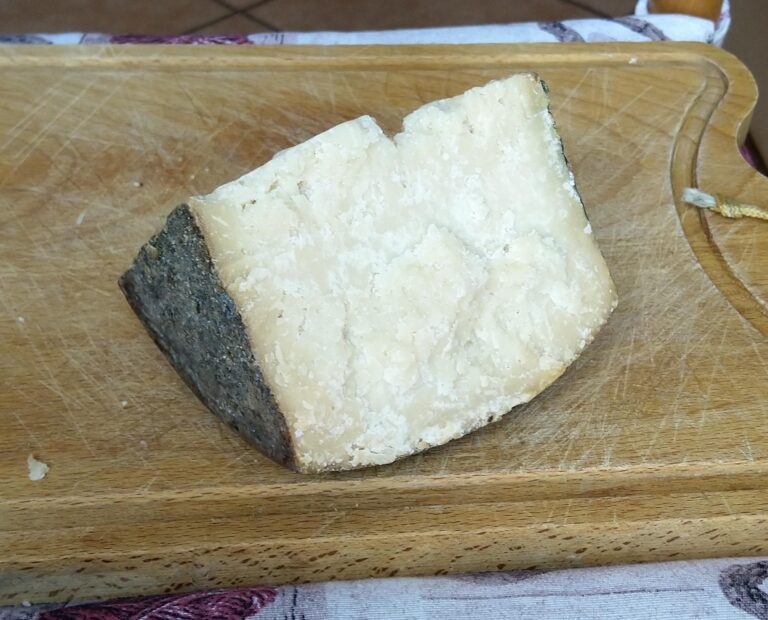
It starts as Sardinian pecorino. To encourage the fly, makers may shorten the brining, pierce small holes in the rind and turn the wheels less often. The larvae feed on the paste and their enzymes break it down into a yellowish cream. Ripening usually takes three to six months, from spring and summer into late autumn. When it’s ready, the top of the rind, su tappu, is lifted off to reveal the cream inside. No two wheels are alike.
Casu marzu has no PDO or PGI. The Region of Sardinia lists it, as casu frazigu, among its Traditional Agri-food Products (PAT), and it appears on Italy’s national list. However, under Italian and EU food hygiene rules it cannot be sold, so you won’t find it in shops or on restaurant menus. In 2005 Sardinian farmers and the University of Sassari began experiments to rear the fly under controlled conditions, but no exemption allowing sale has been granted so far. Health experts point to potential risks from live larvae and non-standard production, though scientific research is limited. It is not advisable for children, pregnant women or vulnerable people.
Tradition calls for spreading it on pane carasau, Sardinia’s crisp flatbread, or on good country bread. Some eat it larvae and all, others remove as many as possible first. The taste is strong, peppery and long-lasting, so a little goes a long way. The classic match is a bold red, Cannonau.
To be clear: casu marzu can’t be bought or ordered. It survives as a family tradition, especially in the pastoral interior, from the Nuoro area to Mandrolisai, with villages such as Dorgali and Sorgono often mentioned in its story. We don’t share addresses or tips. If you want to discover the world it comes from, visit a dairy or sheep farm offering pecorino tastings, try Fiore Sardo PDO and Pecorino Sardo PDO, and join an experience with local shepherds.
It cannot legally be sold, because it doesn’t meet Italian and EU hygiene rules. It is recognised as a Sardinian traditional product (PAT), but that has not made trade possible.
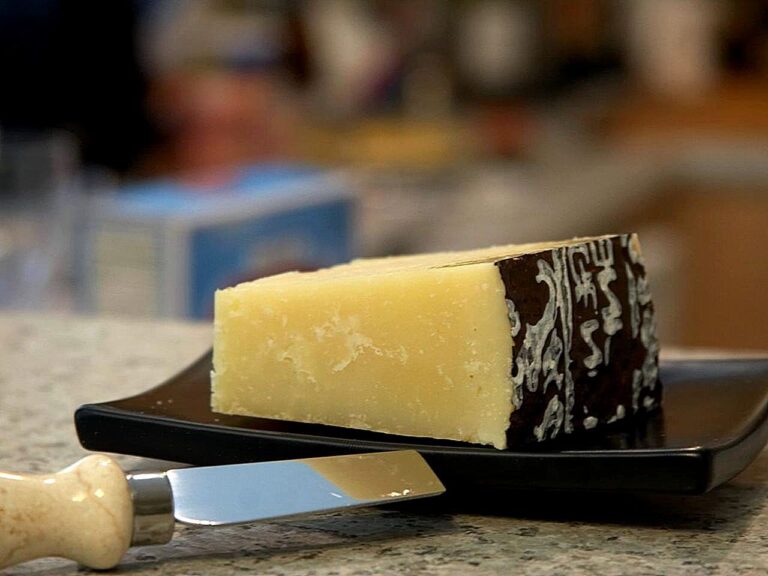
A soft, very sharp and intense cream with a long finish, reminiscent of a heavily aged pecorino. It’s eaten in small amounts, usually on pane carasau.
Health authorities consider it risky because of live larvae and uncontrolled production, although studies are few. Anyone choosing to try it should be cautious.
Do you run activities in Sardinia?
Get your own page on Ajò Sardegna: free until 31 May 2027, no commissions, with customer requests coming straight to you. If you like, we prepare the page for you.
Hi!
Can I help you?
Lia is an AI-based virtual assistant and can make mistakes: always check with the operator. Please don't share personal data. Privacy