Sartiglia of Oristano 2027
Price on request Discover
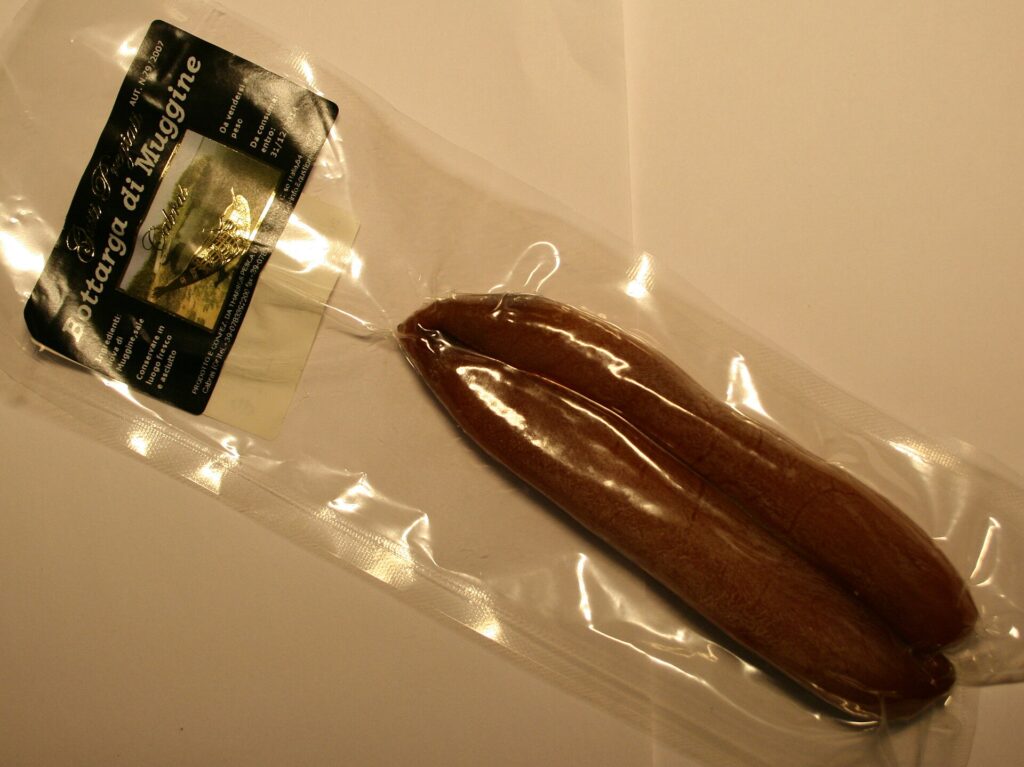
Grate a little over a plate of hot spaghetti and your kitchen fills with the scent of the lagoon. Cabras mullet bottarga – butàriga in Sardinian – is one of our island’s most precious foods: grey mullet roe, salted, pressed and slowly dried into a firm, golden-amber “baffa”. It comes from the shores of the Cabras lagoon, on the Sinis peninsula near Oristano, and carries generations of fishing tradition with it.
Salting fish roe is an ancient Mediterranean craft, often traced back to the Phoenicians, and the word itself comes from the Arabic buṭāriḵ, “salted fish eggs”. For centuries bottarga was fishermen’s food – made at home, taken out on the boats, kept for lean months – before becoming a sought-after delicacy in the second half of the 20th century. Its heart is the Cabras lagoon, one of the largest in Europe (around 2,000 hectares), where since 1982 fishing has been entrusted to local fishermen’s cooperatives, today grouped in the Nuovo Consorzio Cooperative Pontis.
It all starts with mullet caught in the lagoon, mainly from late summer into autumn when the females are full of roe. The two roe sacs are removed whole, cleaned, covered in sea salt for a few hours, pressed and dried. Traditionally drying took place in the open air for weeks; today ventilated rooms are often used. The result is full-flavoured and savoury, with a gentle sweetness and a typical almond finish. You’ll find it whole, sometimes coated in beeswax, or ready-grated in jars.
A friendly tip: read the label. Some bottarga processed in Sardinia is made with imported roe from sea mullet; if you want the lagoon’s own, look for the place of catch.
Cabras bottarga is not a PDO or PGI product, but it is protected as a Slow Food Presidium – “Bottarga di muggine e pesca tradizionale dello stagno di Cabras” – which safeguards the whole world of traditional lagoon fishing, not just the roe.
The classic is spaghetti with bottarga: extra virgin olive oil, a little garlic, and bottarga grated raw off the heat. As a starter, slice it thinly on the diagonal with a drizzle of Sardinian olive oil and some lemon zest, or serve it on buttered toast or with raw artichokes and celery. Pair it with a savoury Sardinian white such as Vermentino, or a Vernaccia di Oristano.
Head to Cabras, where restaurants and local producers serve and sell it, and walk along the lagoon to the Mar’e Pontis fish weir. Oristano and nearby villages such as Santa Giusta and San Vero Milis are good stops too. Every year Cabras holds its Festival della bottarga, which grew out of the long-running local sagra in 2019; recent editions have taken place in September, with tastings, cooking shows and lagoon walks. Dates change each year, so check the town’s official calendar. Fishing-tourism trips on the lagoon are a great way to see the fishermen at work.
Mullet bottarga, typical of Sardinia, is amber and rounder in flavour; tuna bottarga is darker and stronger.
No – it’s used raw. Add it to pasta at the very end, off the heat.
Do you run activities in Sardinia?
Get your own page on Ajò Sardegna: free until 31 May 2027, no commissions, with customer requests coming straight to you. If you like, we prepare the page for you.
Hi!
Can I help you?
Lia is an AI-based virtual assistant and can make mistakes: always check with the operator. Please don't share personal data. Privacy