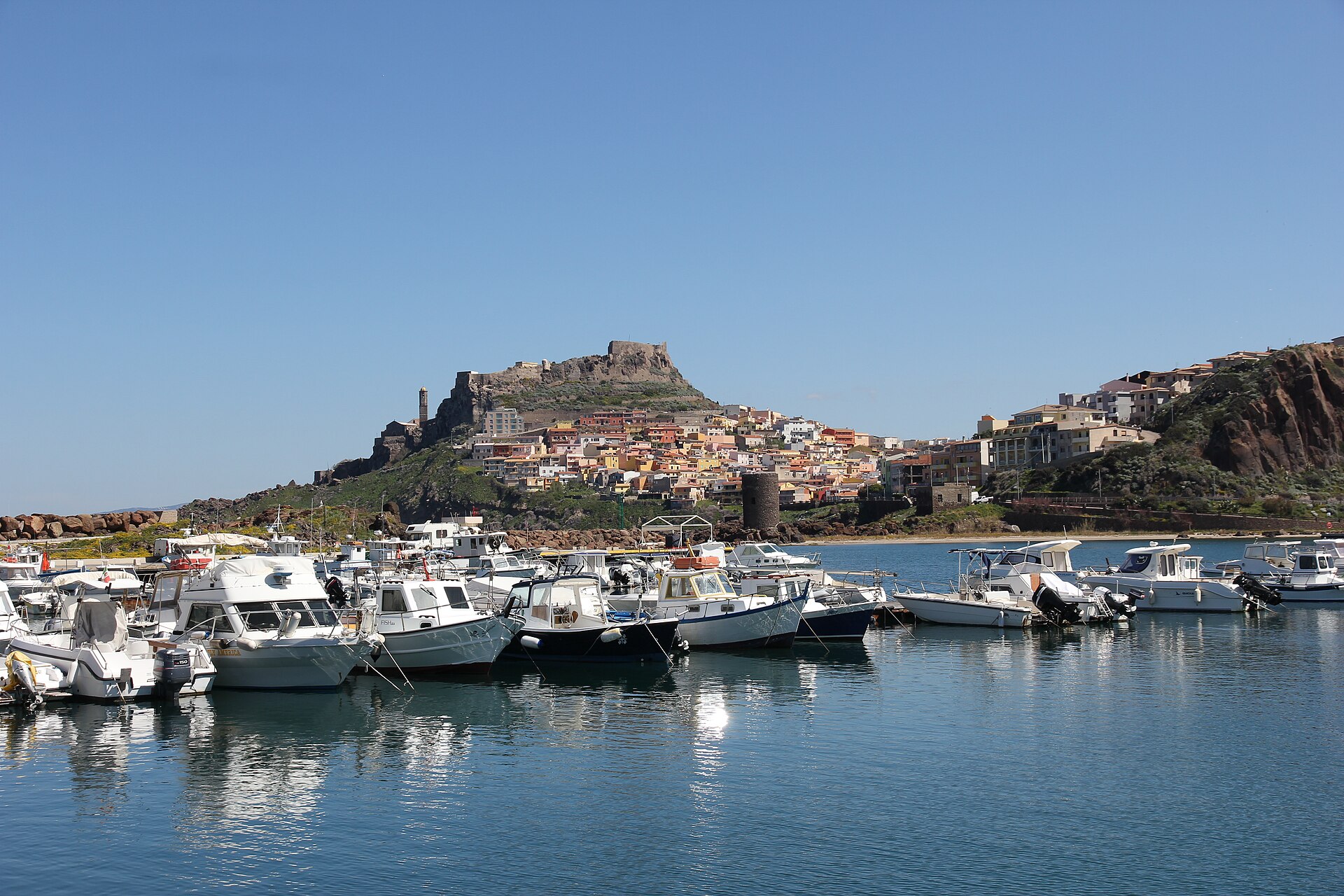
A trachyte headland dropping sheer into the Gulf of Asinara, brightly coloured houses packed tightly together and, at the very top, the Doria castle: you’ll understand what to see in Castelsardo as soon as you reach the road, when the village suddenly appears ahead of you, suspended between sky and sea. It is one of the “Borghi più belli d’Italia” (Italy’s most beautiful villages) and one of the most photographed places in northern Sardinia.
In this guide you’ll find the 12 stops not to miss in Castelsardo, from the castle to the Museo dell’Intreccio Mediterraneo (Museum of Mediterranean Weaving), and from the co-cathedral perched above the waves to Elephant Rock. We also cover the art of basket weaving, the beaches, things to do, the history, the seafood cuisine, the Holy Week rites and all the practical information: how to get here, where to park, where to stay and when to go.
[[TOC]]
Chie naschet tundu non morit cuadru («He who is born round does not die square»)
Traditional Sardinian saying
Why visit Castelsardo
Castelsardo lies in north-west Sardinia, in the province of Sassari, in the middle of the Gulf of Asinara and in the historic region of Anglona. It has around 5,600 inhabitants and is roughly half an hour’s drive from Sassari. The coastline is almost entirely trachyte rock, with cliffs, coves and small inlets, apart from the sandy beach at Lu Bagnu.
The town has a strong personality, built on three things. The first is its medieval history: it was founded by the Doria, a noble Genoese family, and changed its name three times over the centuries. The second is basket weaving (intreccio), the art of working dwarf palm, rush and raffia into baskets, which is still very much alive in the hands of the local basket makers. The third is the Holy Week rites, among the oldest and most intense on the island.
Castelsardo is perfect for anyone who loves historic villages, photographers, those looking for authentic crafts and anyone who wants clear, deep, rocky-shore swimming. It is also a handy base for exploring Anglona, Sassari, Stintino and the coast towards Gallura. If you’re wondering what to see in Castelsardo, be ready to climb plenty of steps: every one rewards you with a better view.
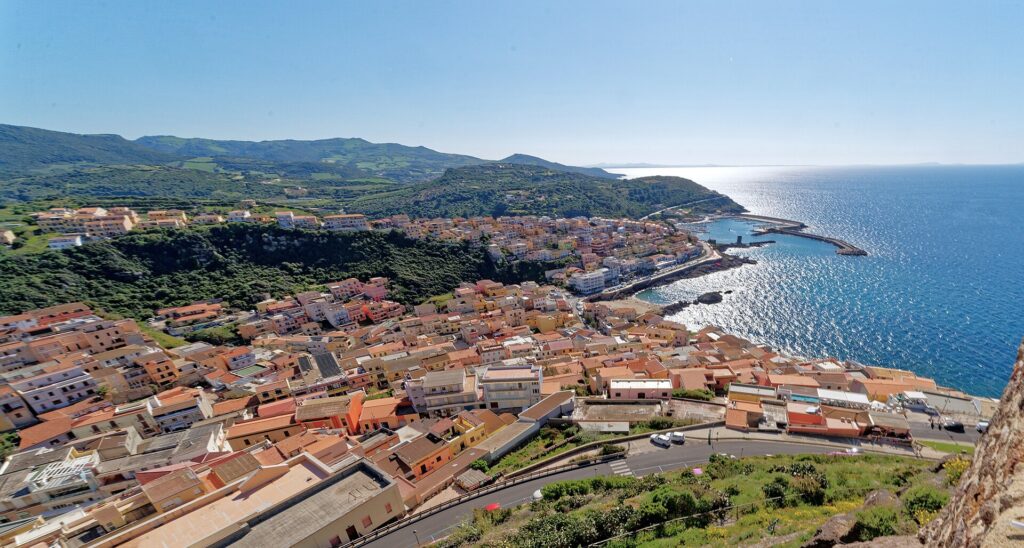
What to see in Castelsardo: the 12 stops not to miss
1. The old town and its alleyways
The old village occupies the upper part of the headland and is partly enclosed by walls. It can only be explored on foot, climbing narrow lanes, archways and stone staircases. The houses, often painted in vivid colours, seem to cling to the rock.
You don’t need a map: just head uphill towards the castle and let the views guide you. On clear days you can see as far as Corsica. The loveliest time is late afternoon, when the setting sun sets the trachyte aglow.
2. The Doria Castle
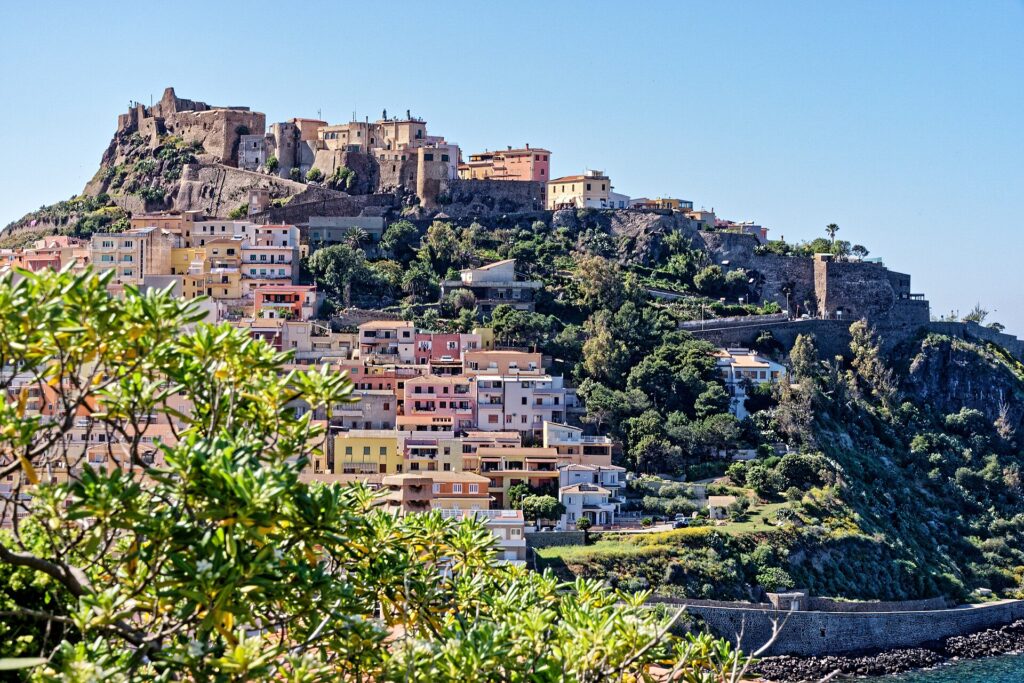
At the top of the village stands the castle that gave rise to the town. Tradition dates its foundation to 1102, but excavations by the University of Sassari point to construction in the second half of the 13th century. The village’s first name was Castelgenovese, in honour of the Doria family.
According to historical sources, Eleonora d’Arborea and her husband Brancaleone Doria lived here for a few years. From the ramparts you get the widest view over the Gulf of Asinara, the harbour and the coast running towards Valledoria.
3. The Museo dell’Intreccio Mediterraneo
Inside the castle is the Museo dell’Intreccio Mediterraneo (MIM), the Museum of Mediterranean Weaving and the most visited museum site in Sardinia, with over a hundred thousand visitors a year. Its nine rooms, spread over two floors, tell the story of plant-fibre weaving in Sardinia and across the Mediterranean.
You’ll see everyday objects, containers for storing farm produce, fishing and farming tools, and items linked to magic and religion. One of the most intriguing pieces is su fassoi, the rush boat used by the fishermen of Cabras and Santa Giusta, displayed alongside Castelsardo’s own basketry: corbules (large, deep baskets), hampers, sieves and strainers.
4. The Co-Cathedral of Sant’Antonio Abate
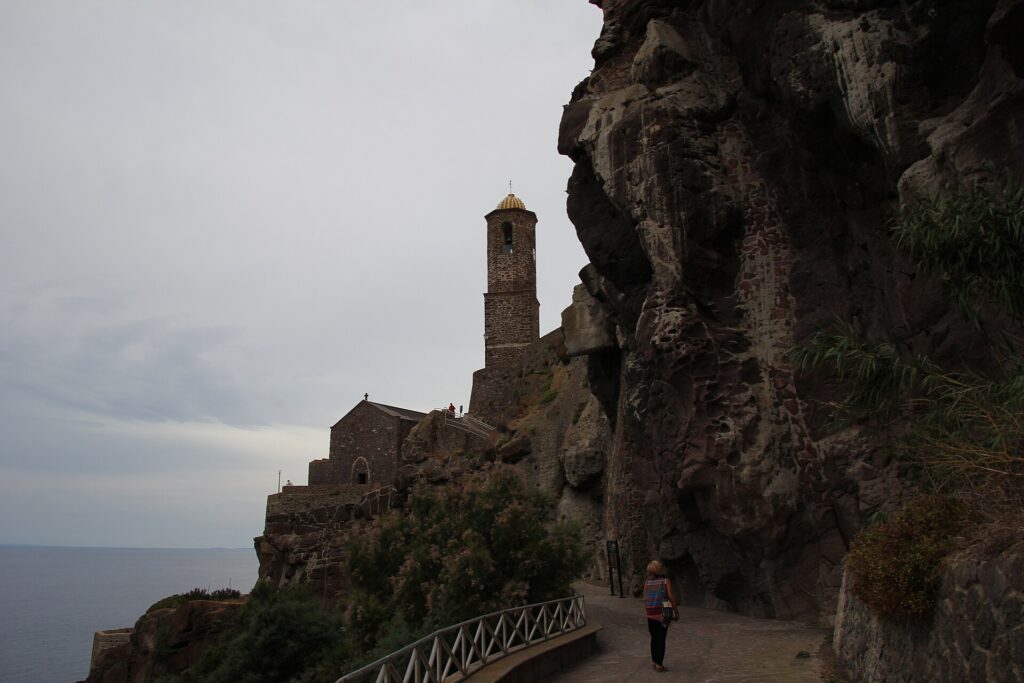
Begun in 1586 on the very edge of the cliff, the co-cathedral has a bell tower topped with a dome covered in coloured majolica tiles, visible from far away. It is one of the town’s symbols and one of the best-known images of Castelsardo.
Inside is the altarpiece by the Maestro di Castelsardo (Master of Castelsardo), an anonymous painter and one of the most important in Sardinia between the 15th and 16th centuries. Castelsardo became a bishop’s seat in the 16th century, when it inherited the role of the ancient diocese of Ampurias.
5. The crypts and the co-cathedral museum
Beneath the church are the crypts, now turned into a small museum housing sacred art, including paintings attributed to the Maestro di Castelsardo. Walking down into chambers carved out of the rock, with the sea just a few metres away, is an atmospheric experience.
6. Santa Maria delle Grazie and the Black Christ
In the heart of the village stands the church of Santa Maria delle Grazie, home to a venerated old wooden crucifix, the Cristo Nero (Black Christ). It is also the seat of the oratory of the Confraternity of Santa Croce, founded in the 16th century and active without interruption ever since. It is the starting and finishing point of the Holy Week rites.
7. The Palazzo della Loggia
On the climb towards the castle you’ll come across the Palazzo della Loggia, a restored historic building that houses the town council. It is one of the architectural jewels of the centre and a reminder of Castelsardo’s status as a Royal City (Città Regia) under Aragonese rule.
8. The basket-weaving workshops
As you wander the alleys you’ll see baskets hanging by the doors and, often, the basket makers at work on their doorsteps. They work dwarf palm, hay and raffia using techniques handed down from mother to daughter. Stopping to watch a basket take shape is the best way to understand the soul of the town.
9. The harbour and Frigiano hill
At the foot of the headland lies the marina, with over 700 berths. The name of the hill, Frigiano, comes from Fritum Janii, the ancient Roman landing place that gave its name to the settlement until the Middle Ages. From the pier you get the best view of the village lit up in the evening.
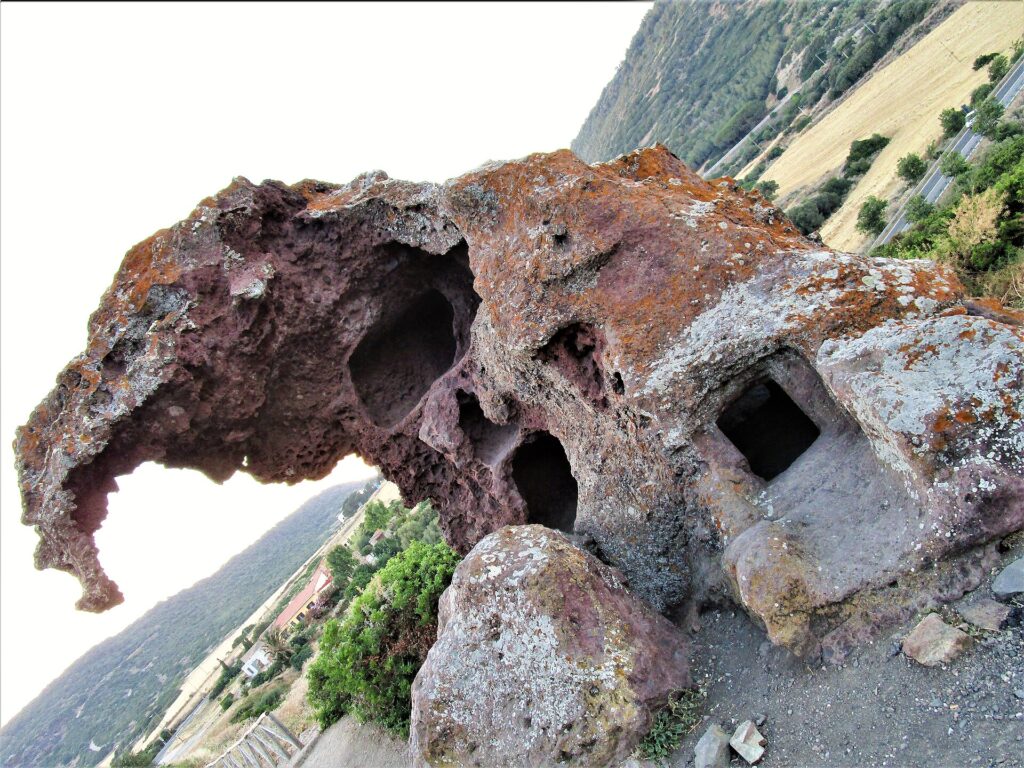
10. Elephant Rock
Along the SS134 road towards Sedini, in the locality of Multeddu, an enormous rust-coloured trachyte boulder bears a striking resemblance to an elephant with its trunk. It broke away from Monte Castellazzu and was shaped over the centuries by wind and rain.
Two domus de janas (“fairy houses”), pre-Nuragic tombs, are carved inside it. In one you can see a bull’s head sculpted in relief, a symbol linked to the cult of the dead.
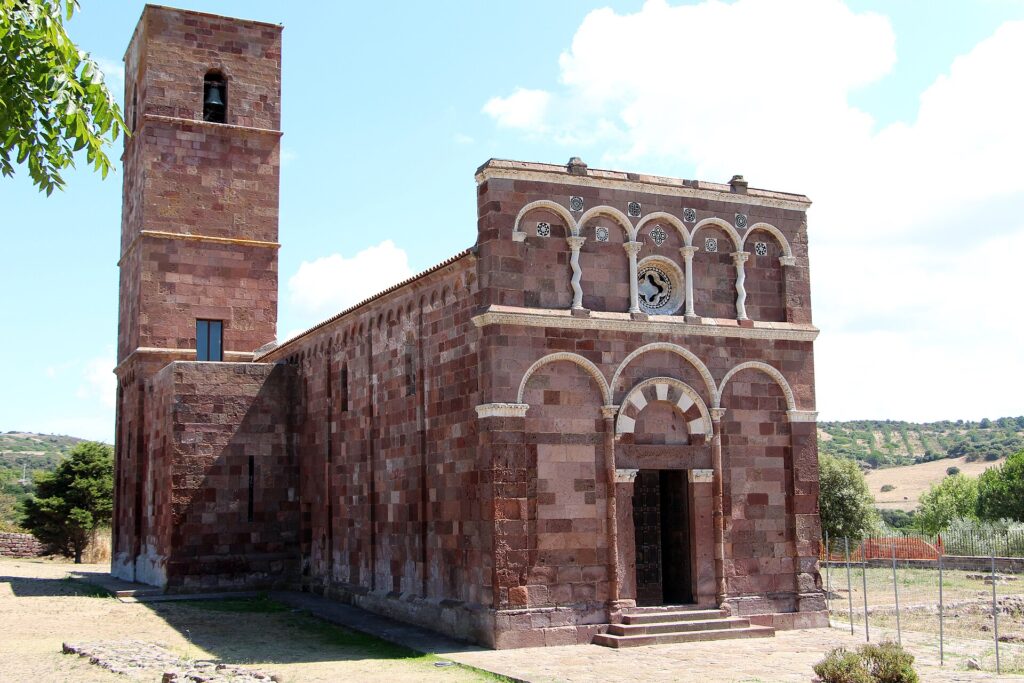
11. Nostra Signora di Tergu
A few kilometres away, set in green countryside, stands the Romanesque basilica of Nostra Signora di Tergu, with its two-tone stone façade. It was the church of a Benedictine monastery and is now the subject of archaeological study and restoration. It is the destination of the Lunissanti pilgrimage, held on the Monday of Holy Week.
12. The sunset viewpoint
End the day by climbing up to the walls or taking the panoramic road that skirts the headland. The sun sinks over the Gulf of Asinara and the co-cathedral’s bell tower glows in the light. It’s the shot almost everyone takes home from Castelsardo.
The art of basket weaving in Castelsardo
In Castelsardo, basket weaving is not a souvenir but a tradition that has lasted for centuries. Baskets were once used for everything: for bread, for grain, for fishing, for carrying produce to market. The women worked at home, often sitting on their doorsteps, chatting with their neighbours.
There are two main techniques: the “cross” weave and the “spiral” weave. The most common fibre is dwarf palm, which grows wild along the Anglona coast, along with hay and raffia. The shapes have precise names: the corbula, large and deep, the canestro (hamper), the sieve and the flour strainer.
The Museo dell’Intreccio Mediterraneo tells the story; the workshops in the old town keep it alive. If you buy a basket, choose someone who works by hand and ask to see how it is made: it is a purchase that directly supports local families.
The beaches of Castelsardo
The Castelsardo coast is mostly rocky, but it has beaches for every taste, from soft sand for families to cliffs for snorkelling fans. You’ll find more ideas for the north coast in our guide to the best beaches in Sardinia.
- Lu Bagnu: about 2 km from the centre, this is the main beach. Sand, shallow water, easy access, facilities and parking: perfect for families and for anyone with limited mobility.
- Ampurias: in the Lu Bagnu district, this is the surfers’ favourite when the mistral blows.
- La Marina di Castelsardo: a small beach of sand and pebbles at the foot of the village, reachable on foot, with calm, sheltered water.
- Cala Ostina: sand and rock, reached by a short path and ideal for snorkelling.
- Punta La Capra: cliffs and small coves with deep water, for confident swimmers; the paths are of moderate difficulty.
A few minutes’ drive east brings you to the long sandy beaches of Valledoria, such as San Pietro a Mare, wide and with shallow water.
Things to do in Castelsardo: experiences not to miss
- Visit the village at sunset, climbing to the castle and then heading down towards the co-cathedral as the lights come on.
- Learn about basket weaving by watching a basket maker at work in the workshops of the old town.
- Go snorkelling among the trachyte cliffs of Cala Ostina and Punta La Capra.
- Take a boat trip from the marina along the Gulf of Asinara: you’ll find ideas in our guide to boat trips in Sardinia.
- Try surfing at Ampurias on mistral days.
- Explore Anglona by car or bike, taking in domus de janas, Romanesque churches and inland villages.
- Witness the Holy Week rites, an experience that stays with you.
To discover everything the area has to offer and book with local operators, visit our page on things to do in Castelsardo.
A brief history of Castelsardo
The area was inhabited as far back as the pre-Nuragic and Nuragic periods, as the domus de janas at Elephant Rock show. In Roman times there was a landing place, Fritum Janii, from which the name Frigiano derives.
The fortified village was founded by the Doria under the name Castelgenovese. In 1448 it was conquered by the Aragonese: it was the last Sardinian town to join the Aragonese Kingdom and in the same year it became a Royal City (Città Regia). It then took the name Castel Aragonese, which was used until the 18th century.
In the 16th century it became a bishop’s seat and work began on the cathedral. In 1767, under Charles Emmanuel III of Savoy, it took its present name, Castelsardo. After a long decline in the 19th century, the town was revived thanks to returning emigrants and tourism. The town’s coat of arms still bears the bars of Aragon.
Even the language tells this story: Castellanese, spoken in the town and in Lu Bagnu, is a transitional variety between Gallurese and Sassarese, with Corsican roots and a syntax close to Sardinian.
What to eat in Castelsardo
Castelsardo’s cooking is all about the sea. The signature dish is aragosta alla castellanese (Castelsardo-style spiny lobster), prepared with a sauce made from the lobster’s own eggs. On the menus you’ll also find clawed lobster, spider crab, red mullet, zerri (picarel), John Dory and, in the colder months, sea urchins.
Alongside the fish are the Sardinian classics: pane carasau (thin crisp flatbread), sheep’s cheeses, almond sweets and seadas (fried pastries filled with cheese and drizzled with honey). To get to know them better, read our guide to traditional Sardinian dishes. To choose restaurants and trattorias in town, see our page on where to eat in Castelsardo.
Festivals and events in Castelsardo
The most important event is Holy Week (Settimana Santa), organised by the Confraternity of Santa Croce, which is of Spanish origin and has been active since the 16th century.
- Lunissanti (the Monday after Palm Sunday): before dawn, the brothers, in white robes and hoods, set out from Santa Maria. Twelve “Apostles” carry the Misteri, the symbols of the Passion, to the basilica of Tergu, on a route of around 8 km. Three choirs of four voices sing the Miserere, the Stabat Mater and the Jesu, hymns of very ancient origin. In the evening the procession returns to the village in the dark, lit only by torches.
- Maundy Thursday: a procession with the statues of the Crucifix and Our Lady of Sorrows, of medieval origin.
- Good Friday: Lu Ilcravamentu, the re-enactment of the Deposition of Christ from the cross.
- Sant’Antonio Abate (17 January): the feast of the patron saint.
- Madonna dei pescatori (Our Lady of the Fishermen, 15 August): a procession at sea with boats.
- New Year’s Eve in the square: an open-air concert in the centre.
Castelsardo in 1, 2 or 3 days
In one day: spend the morning in the old town, visit the castle and the Museo dell’Intreccio, have a seafood lunch, then see the co-cathedral and the crypts in the afternoon, followed by a swim at Lu Bagnu and sunset on the walls.
In two days: add Elephant Rock, the basilica of Tergu and a morning’s snorkelling at Cala Ostina or a boat trip from the marina.
In three days: spend the third day in Anglona, taking in Sedini, Bulzi and Perfugas, or head as far as Stintino and Asinara. Alternatively, follow the coast east to Valledoria and Isola Rossa.
Around Castelsardo
- Sedini (about 15 minutes): the village with a large domus de janas carved into the rock in the middle of town.
- Valledoria and the mouth of the Coghinas (about 15 minutes): long beaches and the river flowing into the gulf.
- Bulzi and Perfugas (about 30 minutes): the Romanesque church of San Pietro di Simbranos and the archaeological museum in Perfugas.
- Sassari (about 35 minutes): Sardinia’s second city, with its historic centre and museums.
- Stintino and Asinara (about 1 hour): Caribbean-style beaches and the national park; read how to get to Asinara.
- Alghero (about 1 hour): the Catalan city, covered in our guide to what to see in Alghero.
- Bosa and Palau: two more stops in northern Sardinia, covered in our guides to what to see in Bosa and what to see in Palau.
If you love towns like this one, take a look at the most beautiful villages in Sardinia too.
Practical information for visiting Castelsardo
How to get there
The nearest airport is Alghero-Fertilia, about an hour’s drive away. From Olbia-Costa Smeralda it takes around an hour and a half. The nearest port is Porto Torres, with ferries from Genoa and other ports, about 40 minutes away. From Sassari it takes around half an hour. There are also regular bus services from Sassari.
Getting around and parking
The old town is on a steep hill and can only be visited on foot, so comfortable shoes are a must. It’s best to leave your car in the car parks along the road below the village or near the harbour; in summer some areas are paid and fill up early. You’ll need your own transport for the beaches and the surrounding area; in summer a shuttle bus runs at Lu Bagnu.
Where to stay
Staying in the old town means waking up with the sea below your window and having restaurants a few steps away, but you’ll be getting around on foot and up stairs. The harbour area and the lower part of town are more convenient if you’re travelling by car. Lu Bagnu is ideal for families who want the beach close by.
When to go
From May to October you can combine the village with the sea. Holy Week, between March and April, is the most moving time to experience the traditions. Autumn and winter are quiet, perfect for the museums and for sea urchins: you’ll find more ideas in things to do in Sardinia in November.
For official information, see the Sardegna Turismo page on Castelsardo.
Frequently asked questions about visiting Castelsardo
How long do you need to visit Castelsardo?
Half a day is enough for the old town and the castle. To add the beaches, Elephant Rock and Tergu, allow one or two days.
Is Castelsardo suitable for children?
Yes: little ones love the castle, Elephant Rock sparks their curiosity and Lu Bagnu has shallow water. Just watch out for the steps in the old town if you have a pushchair. You’ll find more ideas in our guide to Sardinia with children.
What should you buy in Castelsardo?
A hand-woven basket made by the town’s basket makers: it is the most authentic keepsake of Castelsardo.
When does the Lunissanti take place?
On the Monday after Palm Sunday. The procession sets off at dawn for Tergu and returns to the village in the evening, by torchlight.
How do you visit the Doria castle?
You walk up from the old town. The castle houses the Museo dell’Intreccio Mediterraneo, with an entrance ticket; opening times change with the seasons, so check before your visit.
Castelsardo, best enjoyed with the people who live here
Now you know what to see in Castelsardo: the Doria castle, the village alleyways, the co-cathedral above the sea, the basket makers, Elephant Rock, Tergu and the cliffs of the Gulf of Asinara. It’s a town best discovered on foot, at an unhurried pace, stopping to chat with the people who live here. To really experience the area, choose experiences offered by local operators and contact them directly, with no middlemen. Ajò, Sardinia is waiting for you.
