Things to do in Girasole
Things to do in Girasole, Sardinia: Isula Manna beach in the pines, Tortolì lagoon birdwatching, a Catalan Gothic church and the culurgionis festival.
We are gathering the first experiences for this area. Check back soon, or tell us about an operator you know.
Girasole (Gelisuli in Sardinian) is a small coastal village in Ogliastra, on the north-west shore of the Tortolì lagoon, about a kilometre from the sea. With just over 1,300 residents, it stands on a site inhabited for almost three thousand years. It is very handy on arrival: Tortolì-Arbatax airport and Arbatax port are only a few kilometres away. It is perfect for families and for anyone who wants quiet beaches, birdwatching and a taste of culurgionis.
What to see in Girasole
Nostra Signora di Monserrato
Of the village's six historic churches, only the parish church of the patron saint still stands. Built in Catalan Gothic style and reworked in the 16th–17th centuries, it has a white façade and a bell gable; restoration revealed 18th-century frescoes.
Tortolì lagoon
Next to the village, the lagoon, which served as a harbour in antiquity, is an important nature area, home to many bird species and marsh plants.
Things to do in Girasole
Days here are split between sea and nature: swimming and relaxing on the beach, walks and bike rides in the pine wood, and birdwatching on the lagoon. Being close to Arbatax makes it easy to join boat trips along the Ogliastra coast or excursions inland. To plan your day, check the experiences offered by local operators just below.
Beaches of Girasole
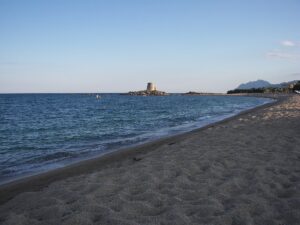
- Isula Manna: pale sand backed by pines, blue water, easy for families.
- The beach towards Lotzorai: a long stretch shared with the neighbouring village, with pine woods behind.
Tortolì's beaches, such as Orrì, are a few minutes away.
History
Some scholars identify Girasole with ancient Sulci on the Tyrrhenian coast, a Phoenician and Carthaginian port and later a Roman trading outpost; excavations found remains of Punic buildings from the 4th–3rd century BC. In the 12th century the name was Gelisoi. In the Middle Ages it belonged to the Giudicati of Cagliari and Gallura, then to Pisa; from 1324 it was a fief of the Carroz family and was freed from feudal rule in 1840.
What to eat and buy
The signature dish is Ogliastra's culurgionis, fresh pasta sealed in a wheat-ear pattern and filled with potato, pecorino and mint, celebrated with its own festival. In January, for Sant'Antonio, people eat broad beans and lard.
Festivals and traditions
- Su Fogoroni, mid-January: the great bonfire for Saint Anthony Abbot.
- Sant'Antioco, two Sundays after Easter: procession, dancing and traditional music.
- Pratzas de Gelisuli, April: open houses, crafts and local food.
- Culurgionis festival, July.
- International folklore festival, August.
- Nostra Signora di Monserrato, early September: the patron feast, with traditional dress and horsemen.
Nearby
- Tortolì-Arbatax: the red rocks and the port.
- Lotzorai: beaches and coastline next door.
- Baunei: the coves of the Gulf of Orosei, reached by boat from Arbatax.
- Triei: the Osono giants' tomb and murals.
Getting there and when to go
Girasole lies on the SS125 Orientale Sarda. Tortolì-Arbatax airport is about 6 km away and Arbatax port about 5 km; Olbia is about two hours' drive, Cagliari about two and a half. June to September is best for the sea; spring and autumn are ideal for birdwatching.
FAQ
Is Girasole good for families?
Yes: Isula Manna beach is easy to reach and the pine wood behind it gives shade.
How far is Arbatax port?
About 5 km, a few minutes' drive.
When can you try culurgionis at a festival?
At the July festival, though you can find them all year.