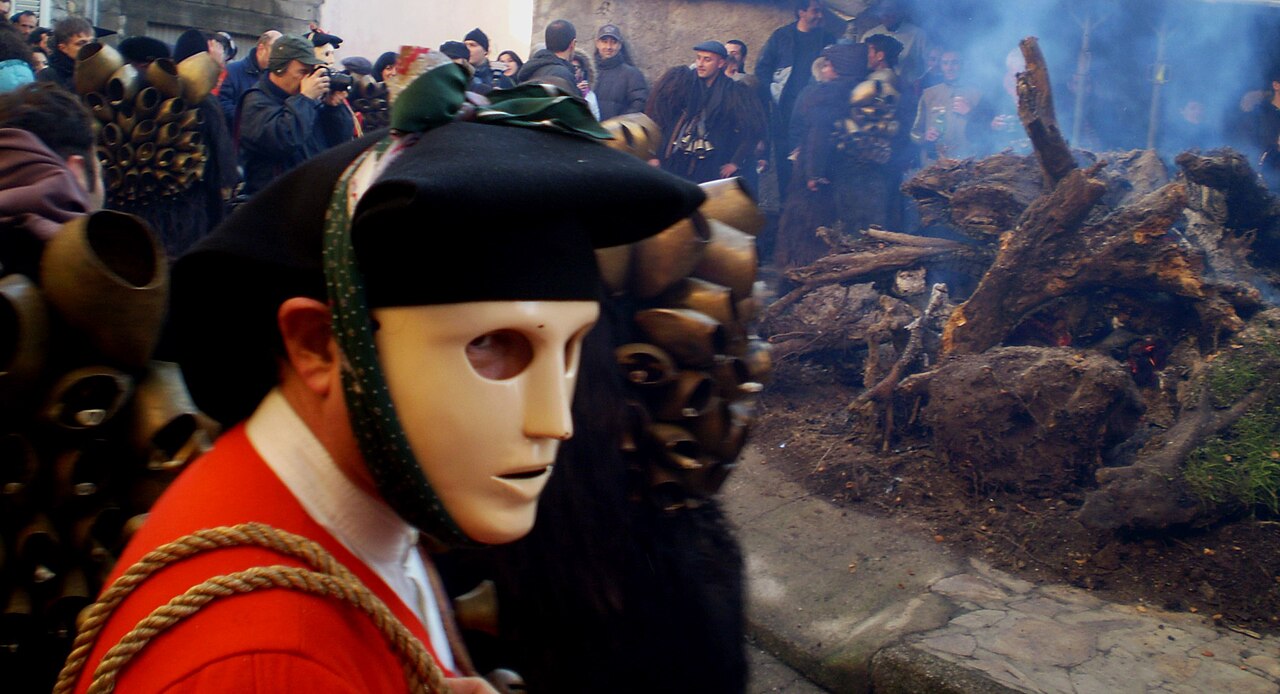
The Mamuthones are the most famous masks in Sardinia: men covered in black sheepskins, their faces hidden behind a dark wooden mask and dozens of cowbells tied to their backs. They move slowly through the streets of Mamoiada, in Barbagia, accompanied by the Issohadores in red jackets, and with every step the air trembles with a deep, unforgettable sound.
In this guide you will find everything you need to see the Mamoiada carnival: who the Mamuthones and Issohadores are, how they dress, when they come out in 2027, what they mean according to scholars and where to discover them all year round, starting with the Museum of Mediterranean Masks. With links to the events and experiences on Ajò Sardegna, which you can book directly, with no commission.
Contents
Who are the Mamuthones
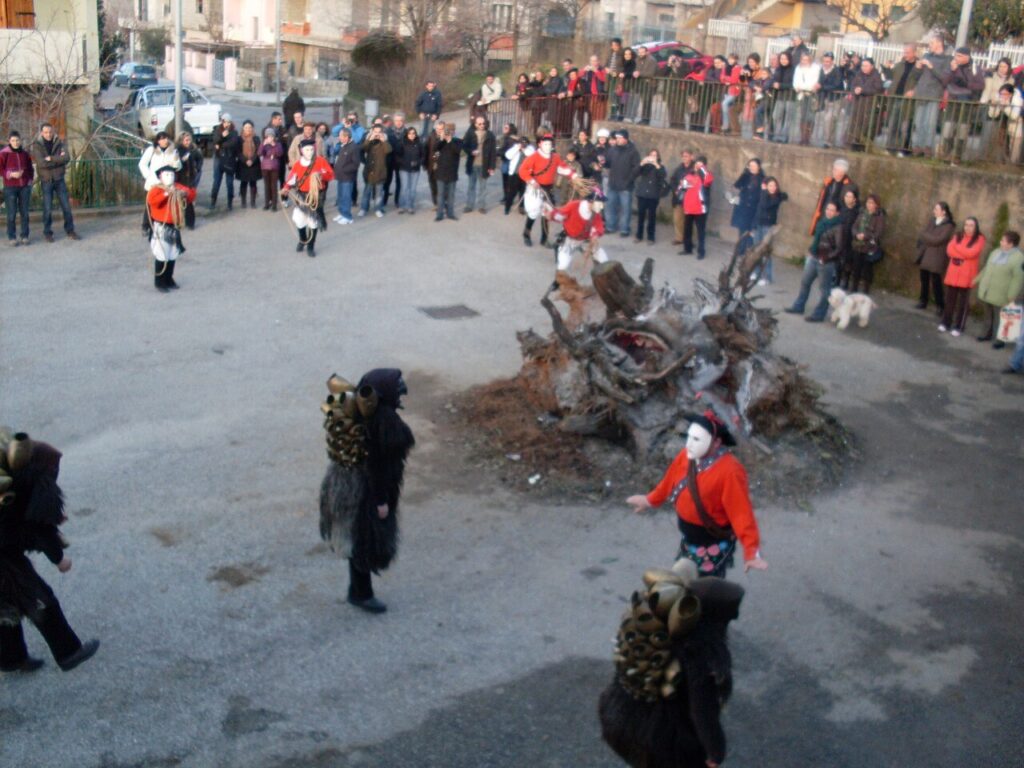
The Mamuthones are the traditional masks of Mamoiada, a village of about 2,500 people in Barbagia, a few kilometres from Nuoro. By tradition they parade in groups of twelve, a number many link to the months of the year, led by eight Issohadores. Today the number may vary, but the structure of the procession stays the same.
The origin of the name Mamuthones is debated. Some scholars link it to the Greek maimon, one who is possessed by a god; in today’s local speech the word can also mean a slightly odd person. What is certain is that in Mamoiada wearing the costume of a Mamuthone is an honour and a responsibility: you learn it as a child and it is handed down in the family.
At Carnival, every prank goes.
Traditional Italian proverb
The carnival of Mamoiada, however, has nothing of the cheerful, colourful party seen in other parts of Italy. It is a slow, solemn ritual, almost a procession, more like an ancient ceremony than entertainment. That is why people seeing it for the first time often fall silent.
The Issohadores, the guardians with the rope
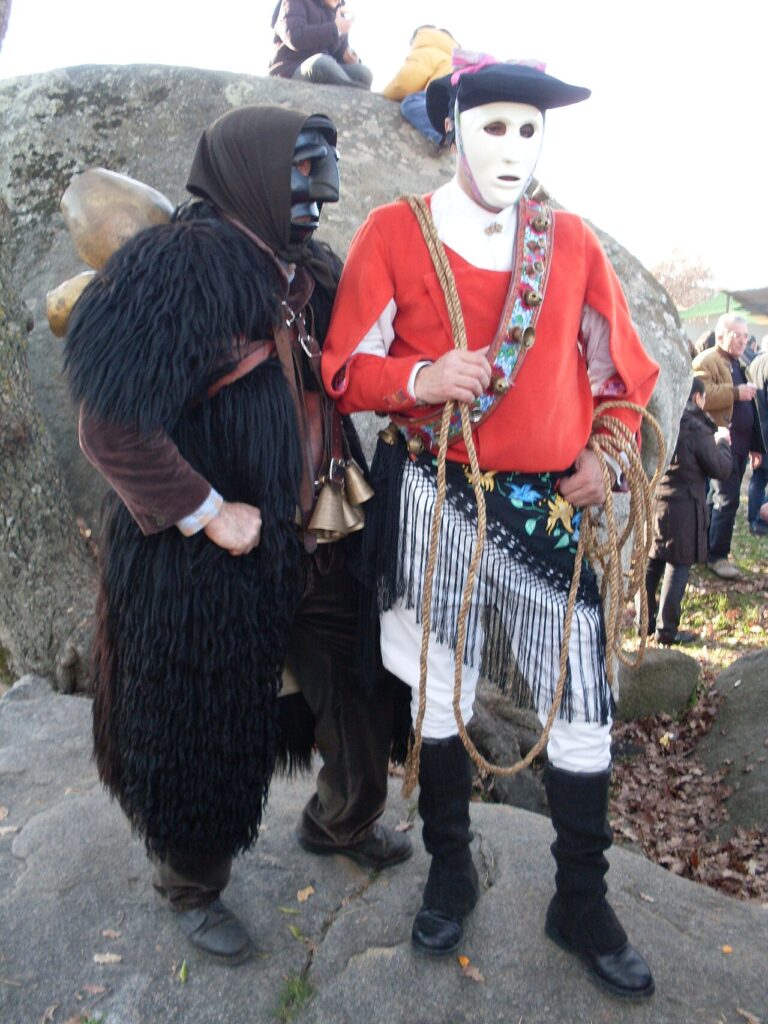
Alongside the Mamuthones walk the Issohadores. Their name comes from soha, the long rope, once made of leather and now of braided rush, which they throw with a quick flick to catch someone in the crowd. They are considered the guardians of the Mamuthones: they set the pace, keep them in line and move nimbly through the crowd.
The Issohadores’ costume is light and colourful: a white linen shirt, a red jacket, white trousers, a woman’s shawl, a bandolier of brass and bronze bells and, for some, a white mask with human features.
The Mamuthones costume piece by piece
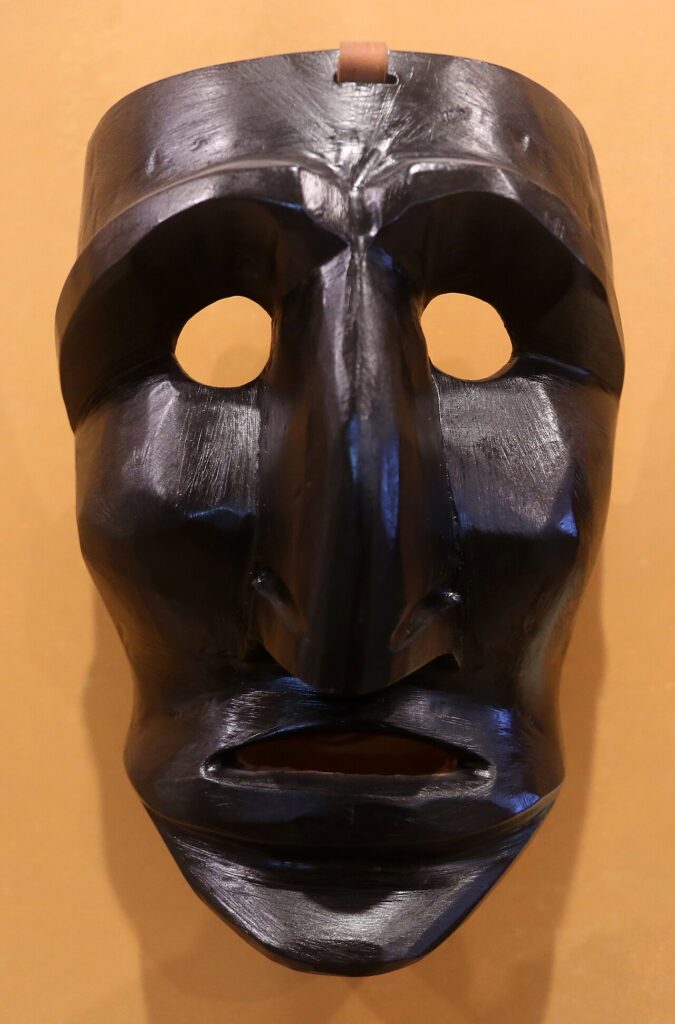
Dressing a Mamuthone is a ritual that takes time and the help of at least two people. Here are the parts of the costume, with their Sardinian names:
- Sa bisera: the black wooden mask, carved from alder or wild pear wood, with a suffering or impassive expression.
- Sas peddhes: the mastruca, black sheepskins worn over a velvet suit.
- Sa carriga: the cowbells tied to the back with leather straps. Together they weigh about 30 kilos (66 lb).
- Sos sonazzos: the smaller bells around the neck, their clappers often made from animal bone.
- Su muncadore: a woman’s headscarf, black or dark red, worn over a man’s cap.
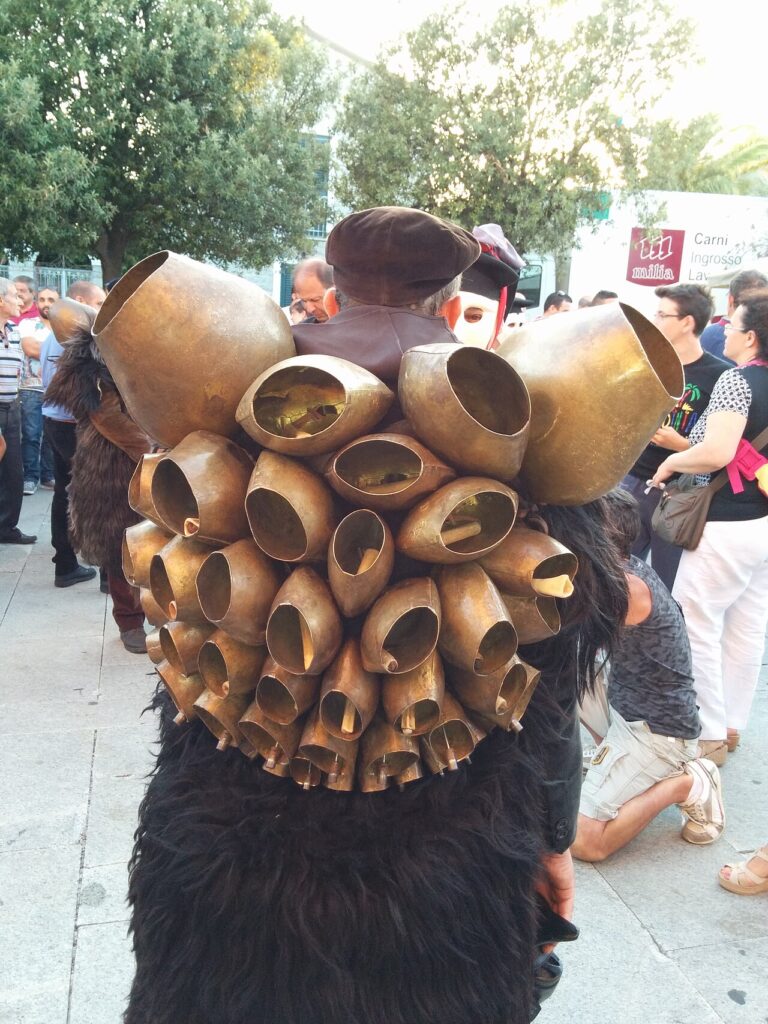
In the past the cowbells often came from the village shepherds, who took them off their animals’ necks or saved worn-out ones. Even today each Mamuthone has his own carriga, and the sound it makes is different from all the others.
The dance: the Mamuthones’ step
The Mamuthones move forward in two parallel lines, bent under the weight of the carriga. Their step is slow and heavy; then suddenly they stop and, all together, shake their shoulders with a sharp jolt, making every cowbell ring at the same moment. At certain points they perform three vertical jumps, precisely synchronised.
The rhythm is set by the Issohadores, who walk alongside and ahead of the procession. It is a difficult choreography, built on glances and understanding: that is why the boys of Mamoiada start practising it at a young age, and every year the crowd waits in silence for the first clang of the cowbells.
When to see the Mamoiada carnival in 2027
The Mamuthones don’t only come out at Carnival. Their first appearance of the year is for the feast of Sant’Antonio Abate, when great bonfires are lit in every neighbourhood of Mamoiada and the masks circle around the flames. In 2027 the date is 16 and 17 January: you will find the page for the Sant’Antonio Bonfires and Mamuthones 2027 on Ajò Sardegna.
The other main appearances are on Carnival Sunday and Shrove Tuesday. In 2027, with Easter on 28 March, they fall on Sunday 7 and Tuesday 9 February: always check the official council programme before you set off. On Tuesday Juvanne Martis Sero also parades, a puppet carried on a cart by men dressed as an uncle and aunt, who mourn him in song: his death marks the end of the carnival.
On the same days, in Oristano, the Sartiglia of Oristano 2027 takes place from 7 to 9 February. With a little planning you can see the Mamuthones on Sunday morning and the Sartiglia on Tuesday, or the other way round: a weekend showing two completely different faces of Sardinian carnival.
The origins of the Mamuthones: what scholars think
Nobody knows for sure when the ritual of the Mamuthones began. There are many fascinating theories. For some scholars it is an extremely ancient rite, perhaps from the nuragic era, linked to the worship of animals and protection from evil spirits. For others it is a farming ceremony to ensure a good harvest, in which the masks represent nature dying in winter and reborn in spring.
There is also a historical reading, recorded by the anthropologist Raffaello Marchi: the Mamuthones would be Moorish prisoners captured by the Sardinians, the Issohadores, who bring them back to the village in chains. Others see traces of the cult of Dionysus in the ritual. The beauty of it is that none of these explanations rules out the others, and in Mamoiada everyone has their own.
The Sardinian Region’s websites gather the main theories: you will find an in-depth article on Sardegna Cultura and the village page on SardegnaTurismo.
The Museum of Mediterranean Masks
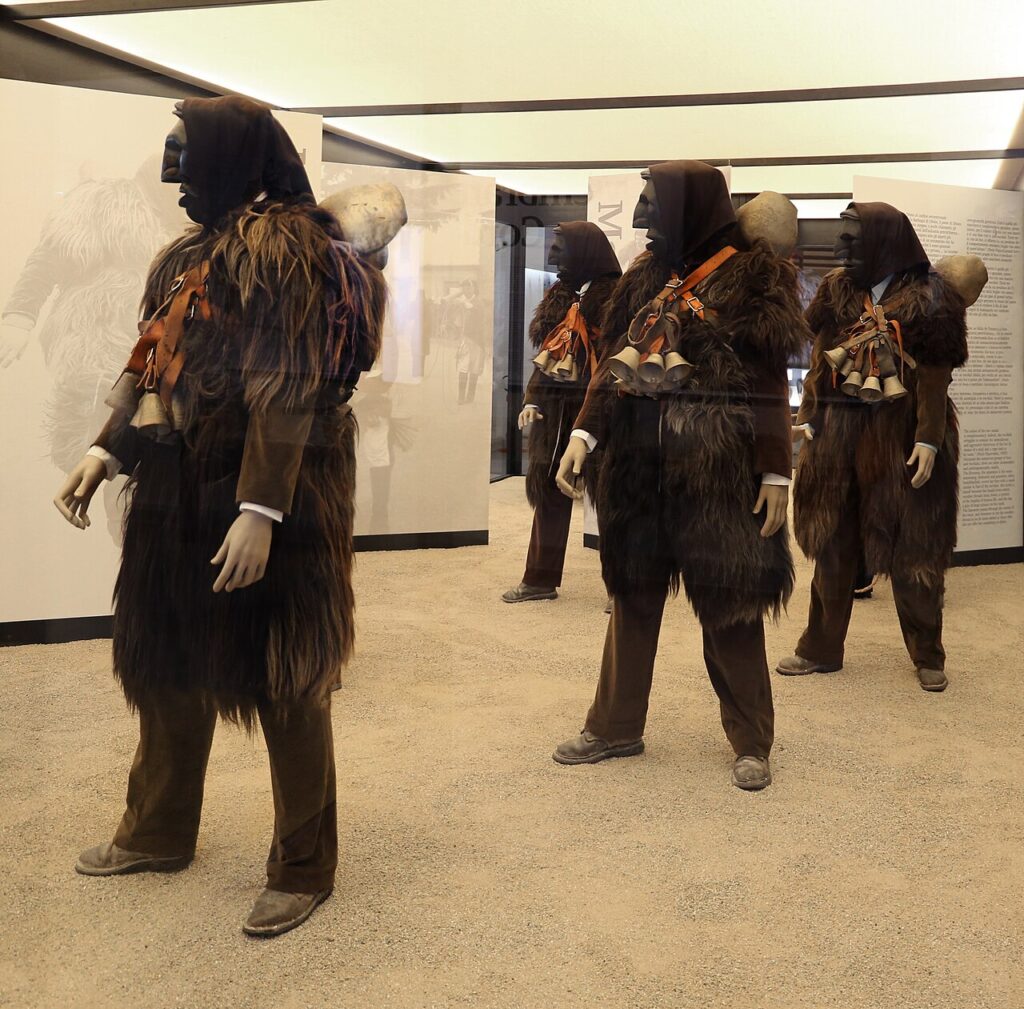
If you can’t come for Carnival, the Museum of Mediterranean Masks in Mamoiada tells the story of the Mamuthones all year round. The museum is open every day except Tuesday and compares the masks of Barbagia with those of other Mediterranean and European countries, through costumes, masks and cowbells. Book your visit directly with the museum.
The museum also runs experiences by appointment. In the traditional mask workshop, from Monday to Friday, you discover how a visera is carved from wood. La Culla dei Mamuthones e Issohadores introduces visitors to the ritual and the people who keep it alive, while schools can book educational workshops during the school year. You will find more culture and traditions experiences on the portal.
The other masks of Barbagia
The Mamuthones are the most famous, but every village in Barbagia has its own masks, and they are well worth discovering. Here are the main ones:
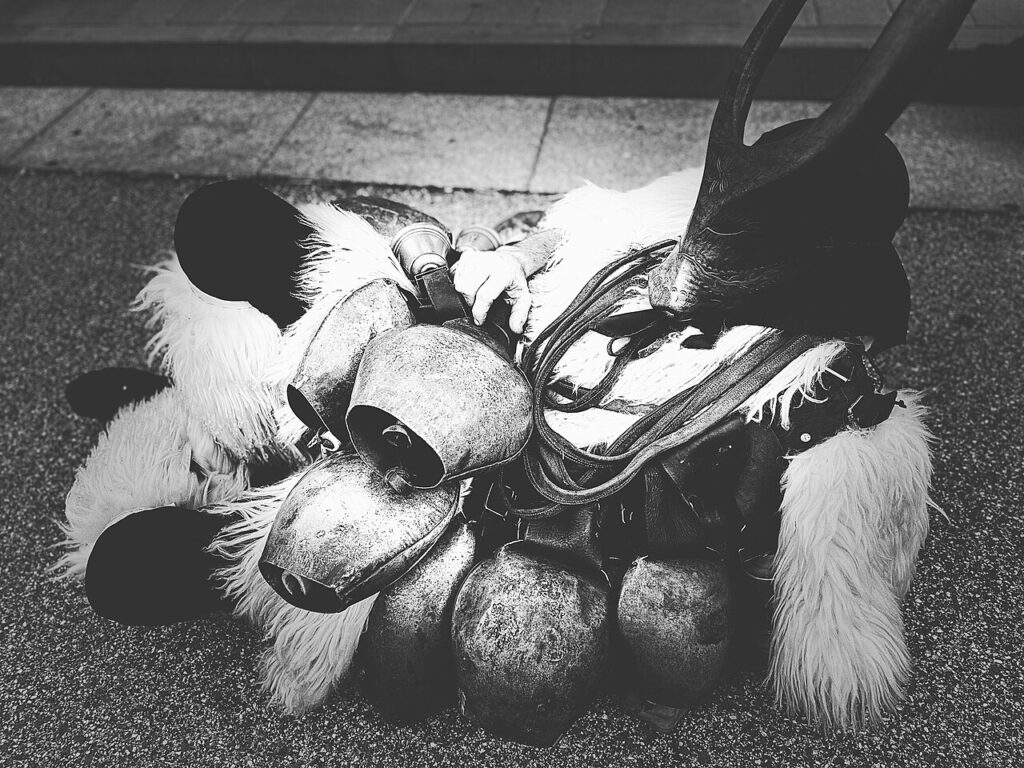
- Boes and Merdules in Ottana: the Boes are men dressed as oxen, with skins and cowbells; the Merdules keep them in check, in a scene that tells of the relationship between man and animal.
- Thurpos in Orotelli: the “blind ones”, wrapped in heavy coats of orbace wool with faces blackened by soot.
- Urthos and Buttudos in Fonni: the bear, covered in skins, and its guardians, who keep it on a chain.
- Don Conte in Ovodda: on Ash Wednesday the village paints its faces black and puts the puppet of Don Conte on trial, before burning him at the end.
Many of these villages are also part of the Cortes Apertas circuit: in December there are still the stops in Fonni, from 6 to 8, and then Ortueri, Orune and Seulo on 12 and 13. All the traditional festivals are collected in the culture section of the portal.
Mamoiada beyond the carnival: wine, food and crafts
Mamoiada is not just about the Mamuthones. The village is one of the most admired areas for Cannonau wine, with dozens of small producers and bush vines on the surrounding hills. A visit to one of the village’s wineries and tastings rounds off a day at the museum perfectly.
At the table you will find the traditional dishes of Barbagia: culurgiones, porceddu, pane carasau, Fiore Sardo and, to finish, seadas with honey. At Carnival people also fry zippulas, the typical fritters of Sardinian carnival. To get to know the island’s cooking better, browse the food and wine experiences.
Craft lovers can look for the master carvers who make the viseras by hand, and for craft workshops where you can learn traditional techniques. Many families in the village have handed down this trade for generations.
A weekend in Mamoiada and the surrounding area
If you are coming for the Carnival or Sant’Antonio weekend, here is a way to spend three unhurried days between Mamoiada and Barbagia.
- Friday: arrive in Nuoro in the afternoon, stroll through the old town and visit the Costume Museum, with its room of Sardinian masks.
- Saturday: morning at the Museum of Mediterranean Masks in Mamoiada, lunch in the village and an afternoon at a local winery. In January, the Sant’Antonio bonfires in the neighbourhoods in the evening.
- Sunday: the parade in the village centre, then a trip to Orgosolo and its murals or towards Oliena, at the foot of the Supramonte.
With an extra day you can go as far as Orgosolo for a guided tour of the murals, or head down to the sea at Cala Gonone for a winter walk. You will find guided hikes in the Supramonte on the portal.
How to get to Mamoiada
Mamoiada lies in the heart of Sardinia, about 15 kilometres from Nuoro. The easiest way to get there is by car: it takes about an hour and a half from Olbia airport and about two and a half hours from Cagliari airport, mostly on the SS131 highway. There are bus connections with Nuoro, but on public holidays they are few and not ideal if you want to stay until evening.
In winter mountain roads can be icy early in the morning: drive carefully, check the weather and keep a blanket and a hot drink in the car. On festival days follow the volunteers’ directions to the car parks, usually set up on the edge of the village, and walk into the centre.
Practical tips for the carnival of Mamoiada
- Arrive early: on festival days the village fills up, and the car parks closest to the centre are full by mid-morning.
- Dress warmly: in January and February it is cold in Mamoiada, especially in the evening around the bonfires.
- Respect the ritual: don’t touch the masks, don’t cross the procession and leave room for the Mamuthones and Issohadores.
- Photos: shoot without flash and without stopping the procession; the best moments are often the waiting ones.
- Where to stay: there are few beds in the village, so book ahead or stay in Nuoro, a quarter of an hour’s drive away.
As for food, on festival days it is best to book lunch at one of the restaurants or farm stays in the area, because tables go fast. In the village you will often find pop-up food stands too, with sandwiches, sweets and local wine. Bring some cash: not everyone accepts cards, especially at the temporary stalls. And if the weather turns, don’t worry: the parades almost always go ahead in the cold and rain, which make the atmosphere even more intense.
Remember that for Mamoiada the carnival is first and foremost a community celebration, not a show for tourists. Anyone who comes with respect and curiosity is warmly welcomed, and often invited to drink a glass of wine in a village home.
The Mamoiada carnival with children
The Mamuthones can frighten small children, with their black masks and the noise of the cowbells. Prepare them by telling the story of the masks beforehand, perhaps with a visit to the museum the day before. The mask workshop is perfect for them: seeing how a wooden visera is made takes away any fear. For more ideas, take a look at activities for kids all over the island.
Frequently asked questions about the Mamuthones
When do the Mamuthones come out in Mamoiada?
Their first appearance of the year is for Sant’Antonio Abate, on 16 and 17 January. They return on Carnival Sunday and Shrove Tuesday, which in 2027 fall on 7 and 9 February. Sometimes they also parade for special events.
How heavy are the Mamuthones’ cowbells?
The carriga, the set of cowbells tied on the back, weighs about 30 kilos (66 lb). On top of that come the sheepskins and the wooden mask.
What is the difference between Mamuthones and Issohadores?
The Mamuthones wear black sheepskins, a dark mask and cowbells, and move slowly. The Issohadores wear a red jacket, white trousers and carry the soha, the rope they use to catch people in the crowd, and they lead the procession.
Can you visit the Mask Museum all year round?
Yes, the Museum of Mediterranean Masks in Mamoiada is open all year except on Tuesdays. It also runs workshops and special tours by appointment.
Experience the carnival of Mamoiada up close
Seeing the Mamuthones live is an experience that stays with you, like the sound of the cowbells. Note the dates, book your museum visit and let yourself be guided by the people who have always lived this ritual. On Ajò Sardegna you will find traditional festivals throughout the year, experiences run by local operators and pages for the villages of Barbagia and the Nuoro area. If you have questions, ask Lia, the portal’s virtual assistant. Happy carnival, and ajò!
