Things to do in Nureci
Things to do in Nureci, Sardinia: murals and cobbled squares, Palazzo Touffani, the Corona 'e su Crobu wall, nuraghi, fossils and the Giara.
We are gathering the first experiences for this area. Check back soon, or tell us about an operator you know.
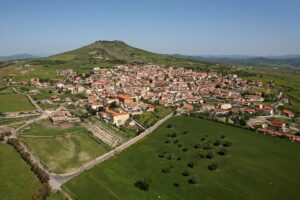
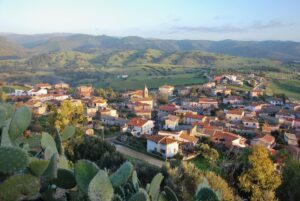
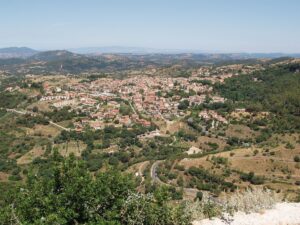
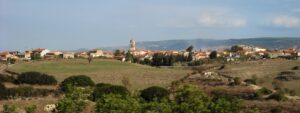
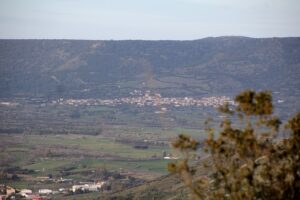
Nureci is a tiny village of a few hundred people on the slopes of Monte Maiore, at the far northern edge of the Marmilla, between the province of Oristano and the Giara plateau. The present village was founded in the 15th century, when the people of nearby Genadas moved here to escape bandit raids. Today it charms with cobbled squares, murals, an ancient megalithic wall and countryside rich in nuraghi (Bronze Age stone towers) and fossils: perfect for lovers of authentic villages and nature.
What to see in Nureci
Old village and Palazzo Touffani
Courtyard houses with stone lintels, balconies and handsome doorways line cobbled squares and lanes with fountains and murals. The highlight is the early 19th-century Touffani baronial palace, linked to the Marseille-born family who held the title of counts of Nureci and Asuni.
Churches
The 17th-century church of Santa Barbara anchors the old centre. In the countryside stands the little church of the Madonna d'Itria, beside the remains of an ancient settlement.
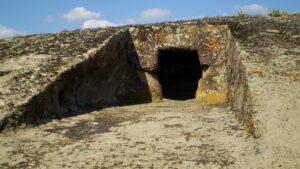
Corona 'e su Crobu
On a cliff edge at the village exit stands this megalithic wall, up to about three metres high in places, of uncertain and perhaps Punic origin. The name means “the crow's rock”.
Nuraghi
The area counts 14 Bronze Age nuraghi, including Attori, on the northern slope of the Giara, and Giuerri Mannu.
Things to do in Nureci
The landscape is made of wide valleys, springs, rock walls and granite and limestone formations: ideal for hiking and nature walks. At Genna Manna – Muru 'e Cubeddu, Miocene marine sedimentary rocks full of fossils come to the surface, a site of real palaeontological interest. The nearby Giara offers walks among cork oaks and ponds in search of the wild ponies. Scroll down to discover the experiences offered by local operators.
History
The area was inhabited in pre-Nuragic and Nuragic times. In the Middle Ages Nureci belonged to the Judicate of Arborea. After its fall it passed to the Aragonese and, under Spanish rule, formed a county with neighbouring Asuni. In 1759 the land was bought by the Marseille merchant Guglielmo Touffani, who became count of Nureci and Asuni; the village was freed in 1839, when feudalism ended.
Food and local products
Life here revolves around farming, sheep rearing and stonework. Religious feasts come with traditional country dishes: rustic bread, sheep's cheeses, roast meats and almond sweets.
Festivals and traditions
- January: San Sebastiano bonfires, an ancient propitiatory rite.
- Tuesday after Pentecost: feast at the Madonna d'Itria country church.
- Late July: feasts of San Giacomo and Sant'Anna.
- Mid-August: an international blues and jazz festival.
- Mid-October: Sant'Ignazio da Laconi.
- Early December: Santa Barbara.
Nearby
- Genoni, with Santu Antine hill and the Giara Pony Museum.
- Laconi, home of Saint Ignatius, with the Aymerich park and menhir museum.
- Assolo and Senis, nearby villages with nuraghi and trails.
- Asuni, historically tied to Nureci.
Getting there and when to go
Nureci is about an hour by car from Oristano and about an hour and a quarter from Cagliari, home to the handiest airport and ferry port; from the SS131 highway you continue on the Marmilla's provincial roads. Spring and autumn are ideal for walking; in August the village comes alive with music.
FAQ
How long do I need for Nureci?
A few hours cover the old centre and Corona 'e su Crobu; a full day if you add the trails or the Giara.
Is Nureci good for families?
Yes, it is a quiet, safe village, and the fossils and the Giara ponies fascinate children.
How far is the Giara from Nureci?
The plateau is just a few minutes' drive from the village.